Wood Pallet Usage

The Trip Count Nobody Talks About: Why Measuring Pallet Life in Years Hides the Real Cost
Associated Pallets research deconstructs how "3-5 year" lifespan claims hide the real cost measured in trips and repairs. Softwood pallets often last just "a few shipping cycles," while hardwood requires repairs every 3-4 trips. The industry harvests 1 million acres of US forest yearly with 40-year growth cycles, while repair costs of $75-125 annually per pallet distribute environmental impact across multiple interventions rather than solving the fundamental problem.
Published By:
Fortune Business Insights
The Industry's Favorite Number: 3-5 Years
Ask any pallet supplier how long wooden pallets last, and you'll hear the same answer: 3-5 years. It's become the industry standard response. But that number obscures a more revealing metric that changes the entire economics conversation.
Let's talk about trips instead of years.
The Metric That Actually Matters
Industry sources acknowledge that measuring pallet lifespan in years "isn't the best way to think about pallet longevity." The number that actually determines cost-effectiveness is trips through the supply chain.
Here's what the data reveals:
Pallet Type | Trips Before Failure | Repair Frequency |
|---|---|---|
Wooden pallets | 15-20 trips maximum | Significant repairs needed every 3-4 trips |
Plastic pallets | 100+ trips | Repairs might be necessary, but far less frequent |
PEER Pallets | Unlimited trips for 10 years | No consumable repairs needed |
Suddenly that "3-5 year" wooden pallet lifespan looks different when you realize it represents only 15-20 trips with mandatory repairs every 3-4 uses.
The Math Nobody Shows You
Let's calculate what this means for a business making 200 pallet trips annually:
Wooden Pallet Model:
Trips per pallet before replacement: 15-20
Pallets needed annually: 200 trips ÷ 18 average = 11-13 replacement cycles
Repairs per pallet: 4-5 times before disposal
Total pallets consumed over 10 years: 110-130 pallets
Plastic Pallet Model:
Trips per pallet before replacement: 100
Pallets needed annually: 200 trips ÷ 100 = 2 replacement cycles
Repairs per pallet: minimal
Total pallets consumed over 10 years: 20 pallets
PEER Pallets Model:
Trips per pallet over 10-year life: unlimited
Pallets needed for 200 annual trips: 200 pallets (reused continuously)
Repairs needed: zero consumable repairs
Total pallets consumed over 10 years: 200 pallets (initial investment only)
The "3-5 year" framing makes wooden pallets seem reasonable. The "15-20 trips" reality reveals they're consumables masquerading as assets.
The Repair Cycle Nobody Accounts For
Here's what sources confirm about wooden pallets: "significant repairs required after every three or four" trips.
Think about what that means operationally:
Usage Pattern | Wooden Pallet Reality |
|---|---|
After 3-4 trips | Requires inspection and likely repair |
After 6-8 trips | Requires second round of repairs |
After 9-12 trips | Requires third repair cycle |
After 12-16 trips | Approaching end of usable life |
After 15-20 trips | Requires replacement |
You're not maintaining an asset. You're extending the life of a disposable item through constant intervention.
The Lifespan Comparison Chart
Multiple industry sources provide data on pallet longevity across materials:
Material | Stated Lifespan | Reality Under Normal Conditions |
|---|---|---|
Wooden pallets | 3-5 years | 1-3 years with heavy use; requires repairs every 3-4 trips |
Softwood pallets | Lower end of range | Shows wear after "just a few shipping cycles" |
Hardwood pallets | Higher end of range | More resistant to splitting but still needs frequent repair |
Standard plastic pallets | 8-10 years | "Can last decade or more with proper maintenance" |
HDPE plastic pallets | 10+ years | Some customers report 10-15 years of constant daily use |
PEER Pallets HDPE | 10 years | Designed for decade of use without consumable repairs |
The Factors They Don't Emphasize
Industry sources list factors affecting pallet lifespan. But look at what they reveal:
Frequency of Use
"Plastic pallets are far better at withstanding frequent use than their wooden counterparts, as they do not splinter."
Translation: Wooden pallets degrade with normal use. The more you use them, the faster they fail. Your operational intensity directly determines replacement costs.
Load Capacity
"Overloading can lead to premature wear or damage."
But what's "overloading"? In time-pressured operations, loads get maximized. Wooden pallets can't handle the actual operating conditions of high-volume logistics.
Handling and Storage
"More often than not, when a wooden or plastic pallet breaks, it is the result of damage from a fork lift truck or other equipment."
So the primary cause of pallet failure is... normal warehouse operations. The equipment you must use to move pallets is what destroys them.
The Environmental Condition Problem Nobody Solves
Sources note that wooden pallets "stored outdoors are more likely to develop mold, rot, or insect infestations."
But also: "Pallets left outdoors or in damp facilities absorb moisture, leading to warped lumber and mold development within weeks."
Within weeks. Not years. Weeks.
If your operation includes any outdoor storage, loading dock exposure, or transportation through varying climates, you're not getting that 3-5 year lifespan. You're getting accelerated degradation and constant replacement.
The Plastic Pallet Alternative... Still Requires Replacement
Industry sources promoting plastic pallets emphasize their 10-year lifespan. But notice the qualifiers:
"With proper care and maintenance, plastic pallets can last a decade or more."
"Quality plastic pallets can make as many as 100 trips through the supply chain, though repairs might be necessary."
Even the better alternative still assumes eventual failure and requires ongoing maintenance. The model hasn't changed—just the timeline.
The Cost Comparison Across True Lifecycle
Let's compare total cost of ownership using trip count as the basis:
For 1,000 Trips Over Time:
Cost Element | Wooden Pallets | Plastic Pallets | PEER Pallets |
|---|---|---|---|
Pallets required (based on trip capacity) | 50-67 pallets | 10-15 pallets | 10 pallets (reused) |
Initial cost per pallet | $40 | $120-150 | $250-280 |
Total initial investment | $2,000-2,680 | $1,200-2,250 | $2,500-2,800 |
Repairs per pallet | 4-5 repairs @ $20 each | 1-2 repairs @ $30 each | $0 |
Total repair costs | $4,000-6,700 | $300-900 | $0 |
Labor for inspections/repairs | $1,500-2,500 | $300-600 | $0 |
Disposal costs | $300-500 | $100-200 | $0 |
TOTAL COST FOR 1,000 TRIPS | $7,800-12,380 | $1,900-3,950 | $2,500-2,800 |
PEER Pallets delivers lower total cost than even plastic alternatives—and eliminates all the hidden maintenance burden.
The "Proper Care" Requirements
Multiple sources mention that longer lifespans require "proper care and maintenance." Here's what that actually entails:
For Wooden Pallets:
Regular inspection schedules
Treating wood with preservatives to prevent rot
Protecting from insect infestation
Storing in dry, indoor environments
Conducting repairs at first sign of damage
Avoiding moisture exposure
Controlling temperature exposure
Managing load distribution
For Plastic Pallets:
Clean regularly with mild detergent
Store on flat surfaces to prevent warping
Avoid prolonged sun exposure (unless UV-resistant)
Inspect for cracks and deformations
Use according to load limits
Proper forklift handling
For PEER Pallets:
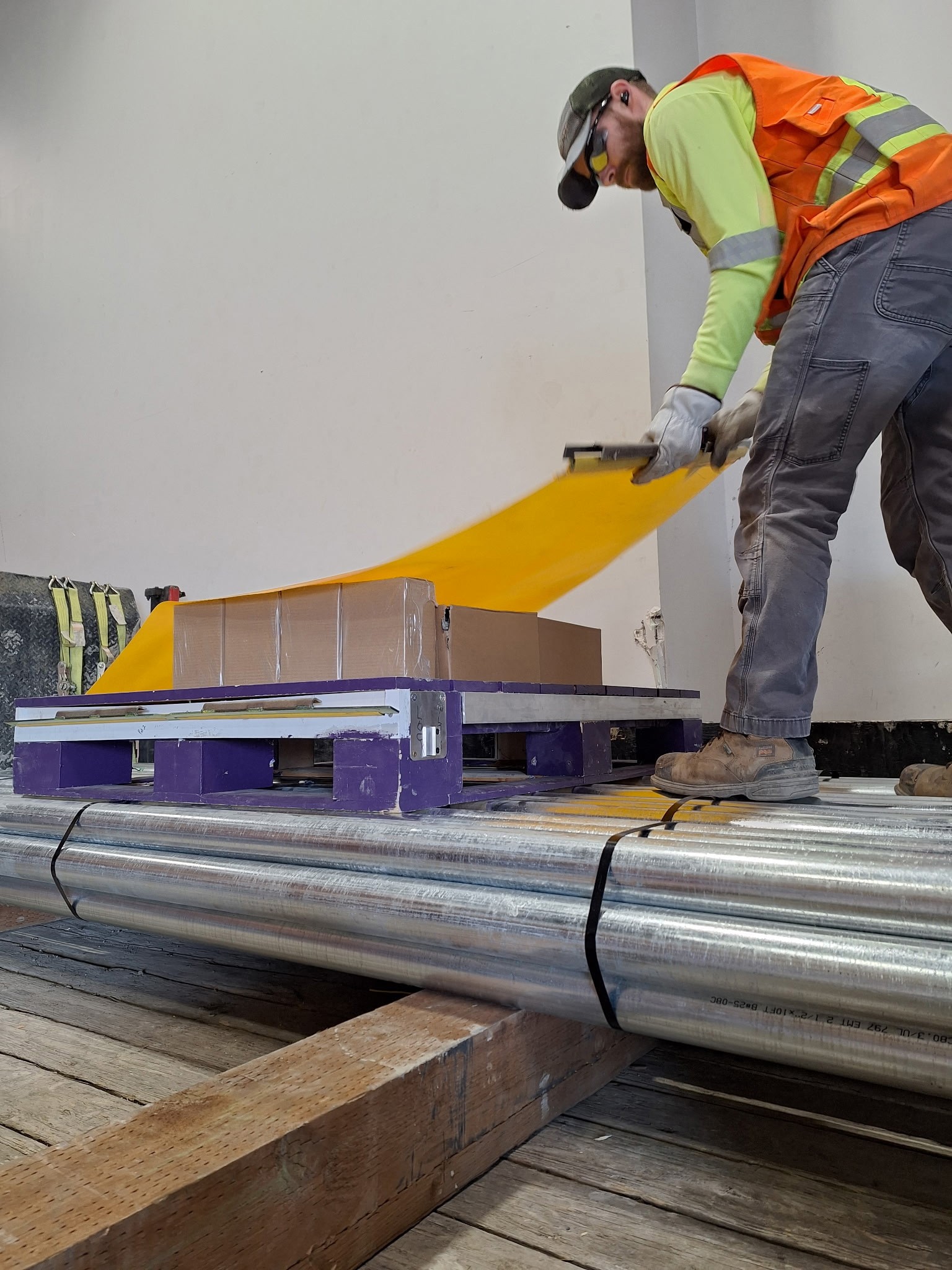
Use the built-in wrapping system as designed
Standard handling with forklifts and pallet jacks
No special storage requirements
No treatment or preservation needed
No inspection protocols beyond normal safety checks
One requires constant intervention. One requires moderate maintenance. One requires virtually nothing.
The Hidden Truth in Industry Data
One source reveals something remarkable: "We have some customers that have used the same plastic pallets across their warehouses and manufacturing plants for 10 to 15 years, despite them being in constant daily use."
This proves durability is achievable with the right design and materials. Wooden pallets' short lifespan isn't an inevitable fact of logistics—it's a material limitation that the industry has accepted rather than solved.
The Sustainability Calculation
Sources note that "plastic pallets are utilized for multiple trips without being disposed of after single-use, eliminating packaging waste going into landfills."
But let's compare actual sustainability across 1,000 trips:
Sustainability Metric | Wooden Pallets | Plastic Pallets | PEER Pallets |
|---|---|---|---|
Units consumed | 50-67 pallets | 10-15 pallets | 10 pallets (no replacement) |
Material waste generated | 50-67 pallets to disposal/recycle | 10-15 pallets eventually | 0 (pallets recyclable at end of true life) |
Stretch wrap consumed | 1,000 trips worth | 1,000 trips worth | 0 |
Plastic waste from wrapping | Massive ongoing waste | Massive ongoing waste | Eliminated |
Even long-lasting plastic pallets still require single-use stretch wrap on every trip. The pallet lasts longer, but the packaging waste continues.
The Questions This Data Raises
If plastic pallets can last 10+ years and 100+ trips, why do we accept wooden pallets that fail after 15-20 trips?
If trip count is the metric that actually matters for cost analysis, why does the industry focus on years?
If handling and environmental conditions cause most failures, why aren't we designing pallets that survive real operating conditions?
If "proper maintenance" is required for longevity, why aren't we building pallets that don't need it?
The PEER Pallets Disruption
The research reveals a clear hierarchy:
Wooden pallets: 15-20 trips with constant repairs
Plastic pallets: 100+ trips with maintenance
PEER Pallets: Unlimited trips for 10 years with integrated reusable wrapping
We're not competing on extending replacement cycles. We're eliminating the need for replacement entirely within a decade-long operational period.
We're not offering better materials that last longer. We're providing a different approach that solves multiple problems simultaneously:
Pallet durability: 10-year HDPE construction
Wrapping costs: Eliminated with built-in reusable system
Maintenance burden: Eliminated with integrated design
Replacement cycles: Eliminated for decade of operations
The Bottom Line
The pallet industry measures success in years because it obscures the constant churn of repairs and replacements. When you measure in trips—the metric that actually determines operational cost—the wooden pallet model reveals itself as fundamentally unsustainable.
Even plastic pallets, while better, still operate within a replacement paradigm. They just stretch the timeline and reduce the frequency.
PEER Pallets offers something different: a system designed for continuous reuse without the constant intervention that both wooden and plastic pallets require.
The question isn't whether PEER Pallets last longer. It's whether your business is ready to stop managing pallet failure as an ongoing operational cost.
Ready to measure success in decades instead of trips? Contact PEER Pallets to learn how our 10-year solution eliminates replacement cycles and wrapping costs simultaneously.