Plastic Pallet Lifespan

The Pallet Material Trap: Why "Choose Your Material" Is Really "Choose Your Replacement Schedule"
Material comparison reveals the industry's "choose your material" framing is really "choose your replacement schedule"—all materials assume eventual failure and continuous stretch wrap use. Wooden pallets warp within weeks outdoors despite "3-5 year" claims, plastic costs 150-250% more but still requires wrapping, metal is overengineered and heavy, and corrugated offers sustainability but sacrifices durability. Premium pricing for "better" materials ignores that all enable the same consumable waste.
Published By:
Fortune Business Insights
The Industry's Material Menu
The pallet industry presents material selection as a choice about performance characteristics. Wood versus plastic versus metal—each with distinct advantages for different applications.
But look past the marketing and you'll see what they're really offering: different rates of consumption. You're not choosing materials. You're choosing how often you'll need to replace them.
The Lifespan Hierarchy They Don't Emphasize
Industry data reveals stark differences in pallet longevity across materials:
Material Type | Stated Lifespan | Trips Before Replacement | Maintenance Requirements |
|---|---|---|---|
Softwood pallets | 1-3 years | "Shows wear after just a few shipping cycles" | Frequent repairs required |
Hardwood pallets | 3-5 years | 15-20 trips maximum | Repairs needed every 3-4 trips |
Standard plastic | 8-10 years | 100+ trips | Moderate maintenance, eventual replacement |
HDPE plastic | 10+ years | Some report 10-15 years constant use | Cleaning and inspection protocols |
Metal pallets | 10-20 years | Extremely durable for heavy-duty | High initial cost, limited flexibility |
Corrugated paper | Single use or limited reuse | Designed for one-way shipments | Not repairable |
Notice the pattern: longer life always comes with higher upfront cost and still assumes eventual replacement.
The Wood Pallet Reality
Sources are candid about wooden pallet limitations:
"Wooden pallets are susceptible to environmental damage like rot, mold, insect infestation, as well as physical damage."
"Wooden pallets stored outdoors are more likely to develop mold, rot, or insect infestations."
"Pallets left outdoors or in damp facilities absorb moisture, leading to warped lumber and mold development within weeks."
Within weeks. Not the promised 3-5 years. Weeks if conditions aren't perfect.
The Hidden Cost of "Affordable" Wood
The pallet industry positions wood as the economical choice:
Stated Advantage | Operational Reality |
|---|---|
"Lower upfront cost" | Requires 10-13 replacements for every 200 trips |
"Easy to repair" | Requires repairs every 3-4 trips |
"Readily available" | Because demand for replacements never stops |
"Biodegradable" | After becoming unusable waste |
You're not buying cheap pallets. You're buying frequent replacements at cheap prices.
The Softwood Trap
Industry sources note that softwood pallets "show wear after just a few shipping cycles."
A few cycles. Not years. Not even months of continuous use. A few trips through your supply chain and they're degrading.
Yet softwood represents a significant portion of the market because the initial price is lowest. Companies optimize for purchase price rather than lifecycle cost—and end up paying more through constant replacement.
The Hardwood Premium That Doesn't Solve the Problem
Hardwood pallets are positioned as the solution to softwood's shortcomings:
More durable construction
Better resistance to splitting
Longer lifespan (the 3-5 year end of the range)
But they still:
Require repairs every 3-4 trips
Last only 15-20 trips maximum
Absorb moisture and warp
Develop rot and mold
Host insect infestations
Need protective treatments
Fail from normal forklift handling
You're paying 40-75% more to slow down inevitable failure. That's not a solution—it's a premium-priced postponement.
The Plastic Pallet Promise
Plastic pallets solve many wood problems:
Advantages Over Wood:
Impervious to moisture, rot, mold
No insect infestation
No splintering or protruding nails
Easier to clean and sanitize
Longer lifespan (8-10 years or more)
Can withstand 100+ trips
What They Don't Solve:
Still require eventual replacement
Still need stretch wrap on every trip
Initial cost 2-3x wooden pallets
Still damaged by normal forklift handling
Still need inspection and maintenance protocols
You're getting better durability, but you're still locked into a replacement model. And you're still generating the same stretch wrap waste on every single trip.
The Usage Pattern Nobody Discusses
Here's what the data reveals about actual pallet lifecycles:
Wooden Pallet Cycle:
Purchase pallet ($30-40)
Use for 3-4 trips
Repair ($15-25 labor + materials)
Use for 3-4 more trips
Repair again
Repeat 3-4 times
Pallet becomes unrepairable
Disposal and replacement
Plastic Pallet Cycle:
Purchase pallet ($120-150)
Use for 20-30 trips
Minor inspection/cleaning
Continue use
Possible repair after 50+ trips
Continue use
Eventually dispose and replace after 100+ trips
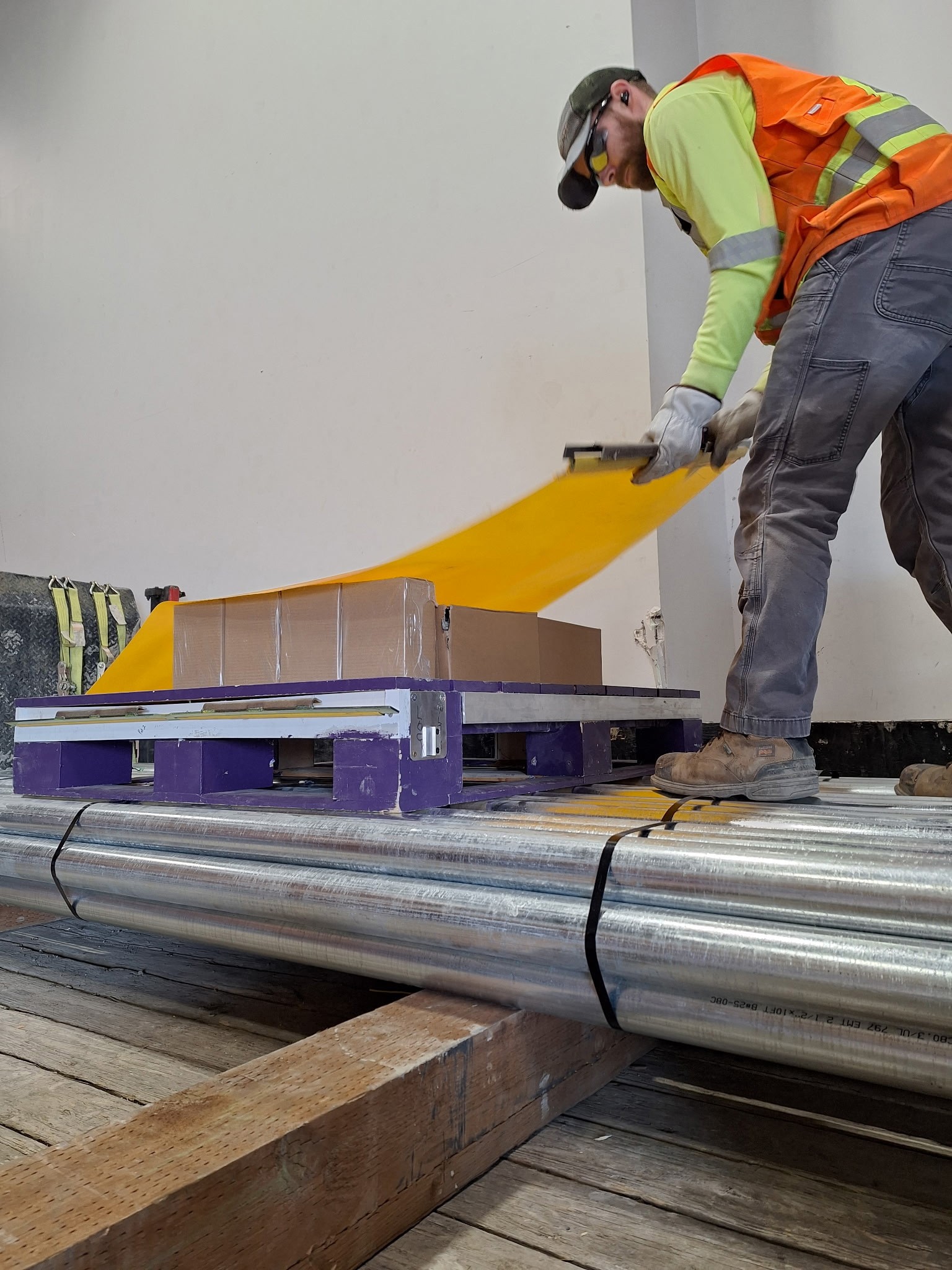
PEER Pallets Cycle:
Purchase pallet ($250-280)
Use for 10 years continuously
Built-in wrapping system eliminates stretch wrap costs every trip
No repairs to consumable wrapping system
At end of decade, recycle HDPE and replace if needed
Only one model eliminates the cycle entirely.
The Application-Based Trap
Industry sources recommend choosing materials based on your application:
"For high-turnover operations with lighter loads, wood pallets may be sufficient and more economical."
Translation: If you move a lot of products, use cheap pallets that need constant replacement. The high turnover justifies the high failure rate.
"For environments that demand hygiene, durability, or longevity—like pharmaceuticals, cold storage, or international shipping—plastic or composite pallets are a smarter investment."
Translation: If you can't afford failures, pay premium prices for less frequent failures.
Why is failure the assumed baseline in both scenarios?
The True Cost Across Applications
Let's compare total cost across different operational profiles:
High-Volume Food & Beverage (500 trips/year):
Material | Annual Pallet Cost | Stretch Wrap Cost | Maintenance | Total Annual Cost |
|---|---|---|---|---|
Wood | $1,200 (27 pallets × $40, + repairs) | $18,000 | $800 | $20,000 |
Plastic | $750 (5 pallets × $150) | $18,000 | $200 | $18,950 |
PEER Pallets | $0 (after initial investment) | $0 | $0 | $0 |
Pharmaceutical/High-Hygiene (300 trips/year):
Material | Annual Pallet Cost | Stretch Wrap Cost | Sanitation | Total Annual Cost |
|---|---|---|---|---|
Wood | Not suitable (contamination risk) | N/A | N/A | N/A |
Plastic | $450 (3 pallets × $150) | $10,800 | $600 | $11,850 |
PEER Pallets | $0 (after initial investment) | $0 | Minimal | ~$200 |
International Shipping (200 trips/year):
Material | Annual Pallet Cost | Stretch Wrap Cost | Heat Treatment | Total Annual Cost |
|---|---|---|---|---|
Wood | $1,600 (20 pallets + treatment) | $7,200 | $400 | $9,200 |
Plastic | $300 (2 pallets × $150) | $7,200 | $0 | $7,500 |
PEER Pallets | $0 (after initial investment) | $0 | $0 | $0 |
No matter the application, PEER Pallets eliminates recurring costs that other materials accept as inevitable.
The Environmental Condition Problem
Sources note that plastic pallets "hold up better in humid or cold storage environments" compared to wood.
But they still don't address the real issue: why do pallets need special environmental conditions to function properly?
Industrial equipment works across temperature and humidity ranges. Shipping containers withstand ocean voyages. Warehouse racking handles diverse conditions.
Why do we accept that pallets—fundamental logistics tools—require controlled environments to achieve stated lifespans?
The Handling Damage Reality
"More often than not, when a wooden or plastic pallet breaks, it is the result of damage from a fork lift truck or other equipment."
This reveals something critical: the primary cause of pallet failure is normal warehouse operations.
Your material choice isn't solving the problem. It's just determining whether that normal operational damage happens quickly (wood) or slowly (plastic).
The Metal Pallet Exception
Metal pallets offer extreme durability:
Can last 10-20 years
Virtually immune to moisture and insects
Extremely high load capacity
Minimal maintenance required
But they come with severe limitations:
Initial cost 4-5x wooden pallets
Very heavy (labor challenges)
Limited flexibility in design
Still require stretch wrap
Disposal challenges at end of life
They solve the durability problem by being overengineered for most applications. And they still don't address the stretch wrap waste issue.
The Single-Use Pallet Admission
Corrugated paper pallets represent the industry's acknowledgment that sometimes pallets are purely consumable:
Designed for one-way shipments
Lower cost than wood
Lightweight
Recyclable after single use
At least they're honest about it. They're not pretending that 3-5 years of frequent repairs represents a durable solution.
The Questions Material Comparison Raises
If plastic can last 8-10 years while wood lasts 3-5 years, why not use plastic exclusively? Cost. The industry has optimized for purchase price rather than lifecycle cost.
If material choice determines replacement frequency, why not choose materials that don't need replacement? Because the industry business model depends on consumption.
If handling damage is the primary cause of failure regardless of material, why not design pallets that survive normal handling? Because we've accepted failure as inevitable rather than as a design problem to solve.
The PEER Pallets Material Decision
PEER Pallets uses HDPE construction—the same material that gives plastic pallets their 10-year lifespan. But we don't stop there:
What We Took From Industry Knowledge | How We Improved On It |
|---|---|
HDPE durability and longevity | 10-year design life matching best plastic pallets |
Moisture and pest resistance | No special storage requirements needed |
Hygienic properties for food/pharma | Food-safe materials throughout |
Structural integrity | Protected wrapping mechanism survives forklift contact |
Recyclability | Full material recovery at true end of life |
But we added what no material choice solves: elimination of stretch wrap consumption.
The Integrated Solution vs. Material Optimization
The industry approach: "Choose the best material for your application, then buy stretch wrap appropriate for that material and application."
The PEER Pallets approach: "Choose a pallet that makes stretch wrap unnecessary, eliminating both pallet replacement and wrapping costs."
We're not competing on materials. We're competing on system design.
The Bottom Line
The pallet industry will help you choose between materials with different replacement schedules:
Wood: Replace frequently, low cost per unit
Plastic: Replace occasionally, medium cost per unit
Metal: Replace rarely, high cost per unit
But all three share the same assumptions:
Replacement is inevitable
Stretch wrap is necessary
Maintenance is required
Failure is just a matter of timing
PEER Pallets rejects those assumptions. Our HDPE construction matches the durability of premium plastic pallets. Our integrated wrapping system eliminates the single-use plastic waste that all other pallets require.
You're not choosing between materials anymore. You're choosing between managing failure and eliminating it.
Ready to stop choosing your replacement schedule? Contact PEER Pallets to learn how our integrated HDPE solution delivers plastic pallet durability without any pallet's stretch wrap waste.