Sustainable Packaging Trend
Related Posts

Environment Canada
Canada Regulations
Single-Use Plastics Prohibition Regulations prohibit manufacture, import and sale of 6 categories of single-use plastics
Persistence Market Research
E-commerce Driver
E-commerce expansion and warehouse automation driving 5-6% annual growth in pallet demand
The Global Movement You've Never Heard Of: How 900 Organizations Are Eliminating Problem Plastics
WRAP's Plastics Pact Network has mobilized 900 organizations across 19 countries to redesign the plastics system, not improve it—142M tonnes of packaging produced annually, 10% recycled, $80-120B in lost value. Their "problematic plastics" criteria (unnecessary, hard to recycle, available alternatives exist) describes stretch wrap exactly, and their reuse-first priority applies directly to pallets.
Published By:
Fortune Business Insights
WRAP's Plastics Pact Network is redesigning the entire plastics value chain—and your industry is in the crosshairs
While Canada debates which single-use plastics to ban, a quiet revolution is happening globally. Over 900 organizations across 19 countries have joined forces through something called the Plastics Pact Network, coordinated by WRAP (the Waste and Resources Action Programme).
Their mission? Completely redesign the plastics system. Not improve it. Not optimize it. Redesign it from the ground up.
For the shipping and logistics industry still wrapping billions of pallets in single-use plastic film, this isn't a distant concern. It's the blueprint for what's coming next.
The Scale of the Problem WRAP Is Tackling
Global Plastic Crisis | Impact |
|---|---|
Carbon emissions from plastic production, use, and disposal | 1.8 billion tonnes per year |
Global plastic packaging produced annually | 142 million tonnes |
Percentage effectively recycled | 10% |
Remainder sent to landfill, incinerated, or leaked | 90% |
Lost economic value | $80-120 billion per year |
Percentage of global carbon budget expected for plastics by 2040 | 5% |
Informal waste workers in unsafe conditions | Over 20 million |
These aren't projections. These are current realities.
What Is WRAP?
WRAP is a UK-registered charity that has become one of the world's leading organizations driving the circular economy. Think of them as the architects behind the global shift away from single-use plastics.
Region | Presence | Impact |
|---|---|---|
Countries with active Plastics Pacts | 19 | Coordinated national action |
Organizations mobilized | Over 900 | Full value chain engagement |
UK market coverage | 75%+ | Consumer plastic packaging |
Global influence | Significant | Setting standards worldwide |
The Five Priority Actions
WRAP has identified five critical interventions needed to fix the broken plastics system. Notice how many apply to shipping and logistics.
Action 1: Eliminate Unnecessary and Problematic Plastics
Current Approach | WRAP's Approach |
|---|---|
Use all plastics until forced to stop | Identify and eliminate problematic plastics proactively |
Wait for government bans | Industry-led elimination using common criteria |
Focus on recyclability alone | Remove items that shouldn't exist in first place |
The Plastics Pact Network uses common criteria across all 19 countries to identify which plastics are "problematic" and should be eliminated.
Criteria for "Problematic" Plastics
Characteristic | Examples |
|---|---|
Unnecessary for function | Excess packaging, decorative elements |
Difficult or impossible to recycle | Multi-layer films, contaminated materials |
Contains harmful substances | Certain additives, microplastic generators |
Lacks viable end-of-life solution | No recycling infrastructure exists |
Available alternatives exist | Reusable or more sustainable options |
Now apply those criteria to stretch wrap.
Action 2: Scale Reuse and Refill Systems
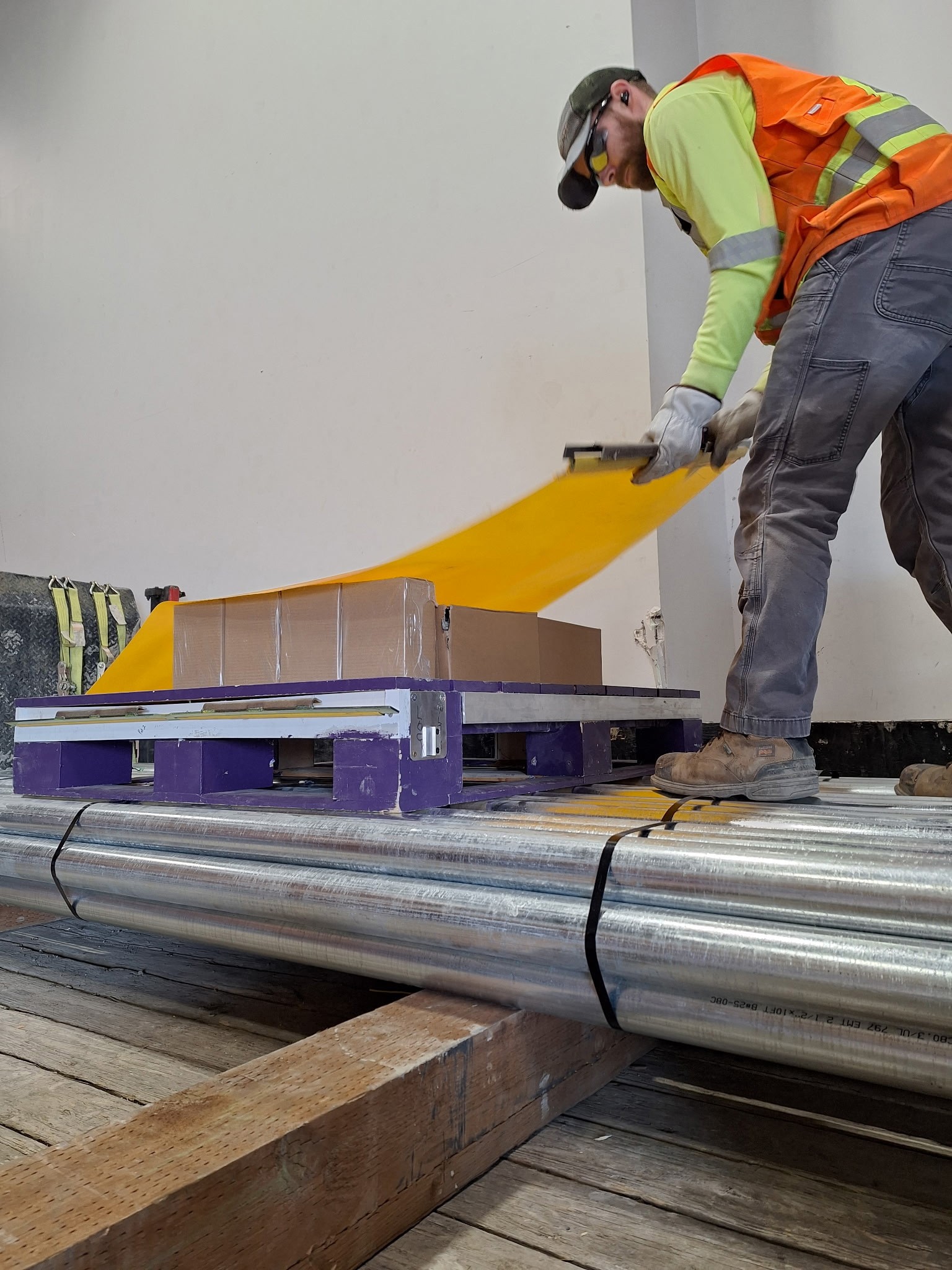
This is where WRAP's work directly intersects with PEER Pallets' mission.
Old Model | New Model |
|---|---|
Single-use packaging | Reusable systems |
Linear economy (make-use-dispose) | Circular economy (make-use-reuse) |
Pilot projects only | Market-wide adoption |
Individual company efforts | Shared infrastructure and standards |
WRAP explicitly states: "Reuse and refill systems are key to reducing single-use plastic packaging."
The Plastics Pact Network is moving from pilot projects to market-wide adoption of reuse models.
Action 3: Design for Recyclability
Achievement | Impact |
|---|---|
Increase in recyclable/reusable/compostable packaging | 23% among Pact members globally |
Industry changes supported | Removing PET bottle colours, simplifying material streams |
Goal | 100% of plastic packaging recyclable or compostable |
But here's the catch: even if 100% of packaging is technically recyclable, we've already seen that only 10% actually gets recycled globally.
Recyclability isn't enough.
Action 4: Effective Recycling in Practice and at Scale
Metric | Achievement |
|---|---|
Plastic recycled by Pact members | Over 5 million tonnes |
Average recycling rate among Pacts | 21% |
UK recycling rate | 55% (highest in network) |
Global recycling rate for comparison | 10% |
Even the best performers are recycling just over half their plastic. The rest still becomes waste.
Action 5: Inclusion of Recycled Content
Achievement | Impact |
|---|---|
Virgin plastic replaced | 2.2 million tonnes |
Average recycled content in packaging | 26% |
Carbon footprint reduction | Significant (recycled plastic has lower footprint) |
UK Plastics Pact progress | Increased from 8% to 24% recycled content |
The UK Plastics Pact: The Trailblazer Model (2018-2024)
The UK Plastics Pact launched in 2018 and has become the blueprint for the global network.
Metric | Achievement |
|---|---|
Reduction in problematic plastics | 99.6% |
Increase in recycled content | From 8% to 24% |
Market coverage | 75%+ of consumer plastic packaging in UK |
Member engagement | Businesses across full value chain |
Government participation | UK governments actively involved |
What "Problematic Plastics" Meant in Practice
The UK Plastics Pact identified specific items for elimination based on evidence. The reduction of 99.6% means these items are essentially gone from the market.
If the UK can eliminate 99.6% of problematic plastics in six years, what makes you think stretch wrap will remain untouched indefinitely?
The Plastics Pact Network: 19 Countries, One Vision
Region | Countries with Active Pacts |
|---|---|
Europe | UK, France, Netherlands, Portugal, Poland |
Americas | USA, Canada, Chile, Colombia |
Africa | South Africa, Kenya |
Asia-Pacific | Australia, Indonesia, India, Vietnam |
And expanding | More countries joining continuously |
Canada's Involvement
Canada has an active Plastics Pact as part of this network, working toward the same targets and using the same elimination criteria as other countries.
This isn't just UK policy. This is coordinated global action.
The Common Targets Across All Pacts
Every Plastics Pact in the network commits to similar targets:
Target Area | Commitment |
|---|---|
Problematic plastics | Eliminate unnecessary and problematic items |
Reusability | Make 100% of packaging reusable, recyclable, or compostable |
Recycling rates | Achieve ambitious recycling targets |
Recycled content | Incorporate significant recycled content |
Timeline | Achieve targets by 2025-2030 |
Notice the timeline: 2025-2030. The same timeline as Canada's zero plastic waste goal.
The Business Case WRAP Makes
WRAP isn't asking businesses to sacrifice profits for the planet. They're showing that the circular economy is economically superior.
Economic Benefits of Circular Plastics System
Current Linear System | Circular System |
|---|---|
$80-120 billion lost value annually | Value retained in economy |
Constant virgin material costs | Reduced material costs through reuse |
Waste disposal expenses | Waste becomes resource |
Regulatory risk and compliance costs | Proactive compliance and market leadership |
Reputation damage from pollution | Sustainability leadership position |
What This Means for Shipping and Logistics
While WRAP's public focus has been on consumer packaging—bottles, bags, food containers—their framework applies to all plastic packaging.
WRAP Action | Stretch Wrap Reality |
|---|---|
1. Eliminate problematic plastics | Stretch wrap is problematic: single-use, rarely recycled, environmental contaminant |
2. Scale reuse and refill | Reusable wrapping systems exist (PEER Pallets) |
3. Design for recyclability | Stretch wrap is technically recyclable but 95.7% becomes waste |
4. Effective recycling | Current recycling is ineffective for stretch wrap |
5. Recycled content | Doesn't solve the single-use problem |
Stretch wrap meets WRAP's criteria for problematic plastic that should be eliminated.
The Social Justice Dimension
WRAP highlights something often overlooked in plastic debates: over 20 million informal workers are involved in collecting and recycling plastic waste, most in unsafe conditions.
Reality | Impact |
|---|---|
Informal waste workers | 20+ million globally |
Working conditions | Unsafe, exploitative |
Health risks | Exposure to toxins, injury |
Economic vulnerability | No protections or benefits |
Geographic concentration | Developing nations bear the burden |
When we talk about eliminating problematic plastics, we're also talking about creating fair, safe systems for everyone in the value chain.
The Global Treaty Connection
WRAP is actively working toward a Global Plastics Treaty with binding rules.
Current Situation | With Global Treaty |
|---|---|
Voluntary action by some companies | Binding rules for all |
Inconsistent national regulations | Harmonized global standards |
Easy to export pollution | Worldwide accountability |
Race to the bottom on standards | Coordinated action toward best practices |
Slow progress | Accelerated transformation |
WRAP's position: voluntary action isn't enough. We need binding international agreements.
The Timeline for Change
Year | Milestone | Impact |
|---|---|---|
2018 | UK Plastics Pact launched | Blueprint created |
2019-2020 | Network expansion begins | Global coordination established |
2021-2023 | Rapid growth | 900+ organizations across 19 countries |
2024 | First Impact Report | Documented elimination of billions of problematic plastics |
2025-2030 | Target deadlines | Pacts achieving their commitments |
What's Already Happened
Achievement | Scale |
|---|---|
Problematic plastics eliminated | Billions of items |
Improvement in reusability/recyclability | 23% increase |
Recycled content in packaging | 44% increase |
Virgin plastic replaced | 2.2 million tonnes |
Plastic recycled | Over 5 million tonnes |
This isn't theoretical. This is documented progress happening right now.
The Recycle Now Campaign
WRAP also runs the "Recycle Now" campaign in the UK, educating citizens about recycling.
But here's the critical insight: even WRAP, which promotes recycling, prioritizes elimination and reuse above recycling.
The Waste Hierarchy WRAP Follows
Priority Level | Action | Application |
|---|---|---|
1. Most Important | Prevent and eliminate | Don't create the waste in first place |
2. Second Priority | Reuse | Use the same item multiple times |
3. Third Priority | Recycle | Only after elimination and reuse exhausted |
Recycling is the last resort, not the solution.
Why This Matters More Than Government Regulations
Government regulations tell you what you can't do. WRAP and the Plastics Pact Network show you what the market is already doing voluntarily.
Government Regulation | Market-Led Transformation |
|---|---|
Forces minimum compliance | Drives competitive advantage |
Punishes laggards | Rewards leaders |
Creates compliance costs | Creates market opportunities |
Reactive stance | Proactive positioning |
Wait for mandates | Lead the change |
900 organizations across 19 countries aren't joining the Plastics Pact Network because regulations forced them. They're joining because they see where the market is heading.
The PEER Pallets Alignment
Everything WRAP advocates for, PEER Pallets already does.
WRAP's Framework vs PEER Pallets Solution
WRAP Priority Action | PEER Pallets Implementation |
|---|---|
Eliminate problematic plastics | Eliminates single-use stretch wrap entirely |
Scale reuse and refill systems | Built-in reusable wrapping system |
Design for recyclability | Entire pallet is recyclable, but designed for decades of reuse first |
Effective recycling | 10-year lifespan before recycling even needed |
Recycled content | Made from HDPE, recyclable up to 15 times |
We didn't wait for WRAP to tell us what to do. We built what they're asking for.
Evidence of Market Readiness
WRAP's work proves something critical: the market is ready for reusable packaging systems.
Indicator | Evidence |
|---|---|
Business participation | 900+ organizations committed |
Geographic spread | 19 countries and expanding |
Value chain coverage | From production through retail |
Investment | Billions in infrastructure and innovation |
Consumer acceptance | Growing demand for sustainable options |
Regulatory momentum | Multiple governments supporting Pacts |
The question isn't whether the market will shift to reusable systems. The question is whether your business will lead or follow.
The Bottom Line
WRAP's Plastics Pact Network represents the largest coordinated effort in history to redesign the plastics system. With over 900 organizations across 19 countries, they're not debating whether to act. They're showing how to act.
Their five priority actions—eliminate problematic plastics, scale reuse, design for recyclability, improve recycling, and use recycled content—provide a roadmap for every industry that uses plastic packaging.
The shipping and logistics industry has so far operated outside this conversation, assuming that industrial plastics like stretch wrap won't face the same scrutiny as consumer packaging.
That assumption is wrong. The criteria WRAP uses to identify problematic plastics applies directly to stretch wrap. The reuse systems they're scaling apply directly to pallets. The timeline they're working toward aligns precisely with Canada's zero plastic waste goal.
WRAP isn't coming for your industry tomorrow. But the framework they've built, the 900 organizations they've mobilized, and the governments they're influencing are creating a world where single-use plastic packaging—all single-use plastic packaging—is recognized as the problematic system it is.
Sources
WRAP (Waste and Resources Action Programme). "Prevent Problem Plastics." 2024.
Plastics Pact Network Impact Report
UK Plastics Pact Annual Report 2023-24
The Waste and Resources Action Programme, UK Registered Charity No. 1159512
Ready to align with the global movement toward reusable packaging systems? Contact PEER Pallets to learn how our built-in reusable wrapping system puts you ahead of the market transformation that WRAP is leading worldwide.