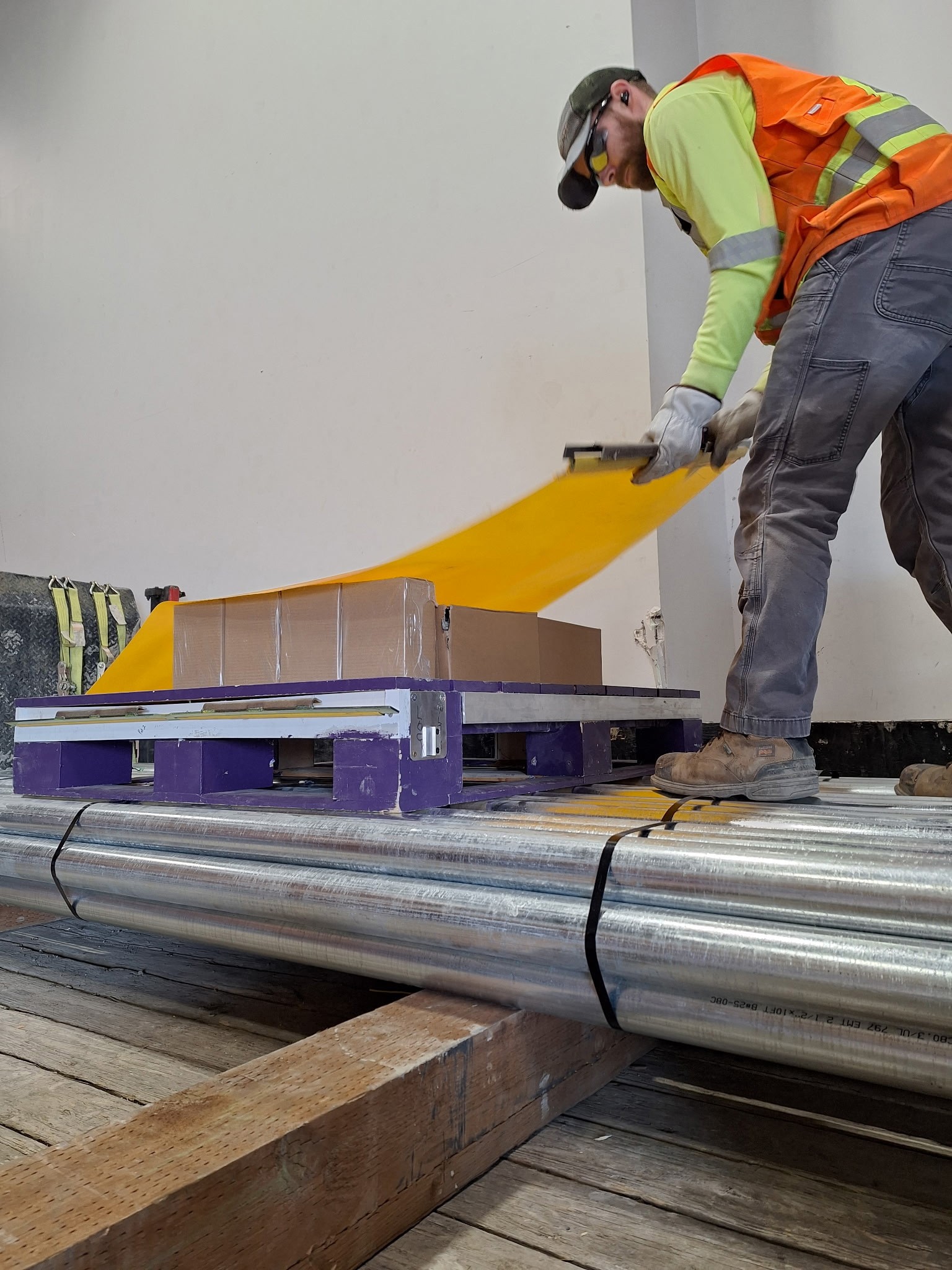
E-commerce Driver


The $132 Billion Question: Where Is the Global Pallet Market Actually Heading?
Persistence's $132B projection by 2033 reveals every growth driver—plastic as the fastest-growing segment, pharma hygiene demands, warehouse automation, EU deforestation rules, circular economy investment—pointing toward integrated reusable systems, not incremental wood-pallet improvements. The industry is already voting against the old model; it just hasn't built the new one yet.
Published By:
Fortune Business Insights
New market research reveals why innovation in pallet design isn't optional—it's inevitable
Persistence Market Research just released comprehensive data on the global pallets market, and the numbers tell a story that every shipping manager needs to understand.
The global pallet market is valued at $92 billion in 2026 and projected to reach $132.3 billion by 2033, growing at a 5.3% CAGR. That's nearly $40 billion in growth over seven years.
But buried in the data is something more important than market size: clear evidence of which direction the industry is moving, and why companies still using traditional single-use packaging are betting against the future.
The Market at a Glance
Market Metric | 2026 Value | 2033 Projection | Growth Rate |
|---|---|---|---|
Global market size | US $92 billion | US $132.3 billion | 5.3% CAGR |
Historical growth (2020-2025) | - | - | 5.3% CAGR |
Total market expansion | - | $40.3 billion | 7 years |
The Regional Picture: Where Growth Is Happening
Asia-Pacific: The Undisputed Leader
Regional Metric | Current Status |
|---|---|
Market share (2026) | 45.1% |
Growth rate | Fastest-growing region globally |
Key drivers | Rapid industrialization, export manufacturing, e-commerce boom |
Major markets | China and India |
Government support | PM Gati Shakti (India), logistics corridor expansion (China) |
North America: Mature but Innovating
Regional Metric | Current Status |
|---|---|
Market share (2025) | 30.5% |
Key characteristics | Mature logistics networks, warehouse automation, strict regulations |
Innovation focus | RFID-enabled smart pallets, last-mile delivery optimization |
Major players | Amazon, Home Depot driving demand |
Regulatory impact | Build America, Buy America Act supporting domestic production |
Europe: The Sustainability Leader
Regional Metric | Current Status |
|---|---|
Market share (2025) | 19.0% |
Key drivers | Environmental policies, circular economy commitment |
Regulatory framework | EU Regulation on Deforestation-free Products (2023) |
Focus areas | Recycled plastics, certified wood sources, smart tracking systems |
Sector demand | Food & beverage, automotive, pharmaceuticals |
Material Type Analysis: The Battle for Market Share
Wood Pallets: Still Dominant, But...
Wood Pallet Metrics | Current Status |
|---|---|
Market share | 45% of revenue |
Key advantages | Cost efficiency, durability, ease of repair, broad acceptance |
Compliance trend | ISPM-15-compliant products increasing |
Sustainability focus | Sustainably sourced wood gaining traction |
Primary users | Manufacturing, pharmaceuticals, general logistics |
The Problem Wood Pallets Face
Challenge | Impact |
|---|---|
Raw material price volatility | Production cost spikes, margin pressure |
EU deforestation regulations | Market access restrictions, compliance costs |
Limited lifespan | 1-3 years average, constant replacement needed |
Repair requirements | Ongoing maintenance costs |
Hygiene limitations | Cannot be fully sanitized for sensitive industries |
Plastic Pallets: The Fastest-Growing Segment
Plastic Pallet Metrics | Growth Drivers |
|---|---|
Growth status | Fastest-growing segment through 2033 |
Key advantages | Moisture resistance, chemical resistance, recyclability |
Technology integration | RFID tracking, IoT compatibility |
Primary demand sources | Pharmaceuticals, food safety, e-commerce, automated warehouses |
Sustainability benefit | Recyclable, longer lifespan than wood |
End-User Analysis: Who's Driving Demand?
Food & Beverage: The Current Leader
F&B Sector Metrics | Current Status |
|---|---|
Revenue share (2025) | 38.0% |
Key requirements | Hygiene, pest control, contamination prevention |
Material preferences | Plastic or ISPM-15 certified heat-treated wood |
Growth drivers | Global food trade expansion, e-commerce food delivery |
Notable investment | DS Smith Plc: €6M ($6.45M) Netherlands expansion for sustainable pallets |
Pharmaceuticals: The Fastest-Growing User
Pharma Sector Metrics | Growth Drivers |
|---|---|
Growth status | Fastest-growing end-user segment |
Key requirements | Sterile, contamination-free transport |
Material preferences | Recyclable plastic, composite materials |
Innovation needs | Cold-chain compatibility, RFID tracking, IoT integration |
Market impact | COVID-19 accelerated pharmaceutical logistics expansion |
Compliance focus | Traceability, temperature monitoring, global health standards |
The Three Major Market Drivers
Driver 1: Surging International Trade
Trade Growth Metrics | Impact on Pallets |
|---|---|
Global trade increase (H1 2025) | $300 billion |
Quarterly growth rate | 1.5-2% |
Key requirement | Standardized load carriers for cross-border supply chains |
Regulatory compliance | ISPM-15 for international shipping |
Supply chain complexity | Multimodal transport networks requiring robust solutions |
Driver 2: E-commerce and Automation Boom
E-commerce Metrics | Market Opportunity |
|---|---|
Global sales from online purchases | Approximately 20% |
B2B e-commerce market growth | 14.5% CAGR through 2026 |
Warehouse requirements | Higher SKUs, increased fulfillment volumes |
Automation compatibility | Need for stackable, standardized pallets |
Technology integration | Compatibility with robotics and AGVs |
Driver 3: Sustainability Requirements
Sustainability Trend | Market Impact |
|---|---|
Circular economy focus | Shift toward reusable, recyclable pallets |
Regulatory pressure | EU deforestation rules, environmental standards |
Cost-benefit alignment | Sustainability meeting cost efficiency goals |
Innovation direction | Smart, sustainable pallets with integrated tech |
Market Restraints: The Hidden Costs
Challenge | Impact |
|---|---|
Lumber price fluctuations | Unpredictable production costs |
Profit margin pressure | Difficult to maintain consistent pricing |
EU deforestation regulations | Supply restrictions, market access issues |
Cost pass-through | Consumer price increases, demand suppression |
Vulnerable sectors | Agriculture, manufacturing (price-sensitive) |
The Smart Pallet Opportunity
The report identifies a critical growth opportunity that aligns perfectly with PEER Pallets' vision.
What the Market Research Says
"The growing adoption of smart, sustainable pallets that integrate RFID, recyclable materials, and cold-chain compatibility presents significant opportunities across pharmaceuticals, food logistics, automated warehousing, and cross-border trade networks."
Smart Pallet Characteristics
Feature | Benefit |
|---|---|
RFID integration | Real-time tracking, inventory management |
IoT connectivity | Temperature monitoring, location data, condition tracking |
Recyclable materials | Circular economy compliance |
Cold-chain compatibility | Pharmaceutical and food safety applications |
Automation-ready design | Works with robotics and AGVs |
Long lifespan | Reduces replacement costs |
Recent Industry Innovations
The report highlights three recent developments that show where the market is heading:
Innovation 1: ACL Airshop & IndiGo Partnership (August 2025)
Partnership Detail | Significance |
|---|---|
Scope | Standardized pallet management, maintenance, tracking |
Location | India market entry for ACL |
Technology | Advanced tracking services |
Outcome | Improved fleet efficiency and visibility |
Innovation 2: Coca-Cola Vietnam NetZero Pallet (July 2025)
Innovation Detail | Impact |
|---|---|
Material | Agricultural waste (coconut fiber, coffee husk) |
Carbon impact | Carbon-negative, sequesters up to 34 kg CO2 per pallet |
Deployment | Automated warehouse pilot |
Scale potential | Could save 10 million trees, recycle 2 million tons waste |
Benefits | 7 million tons CO2 storage, supports 600,000+ farmers |
Innovation 3: Cold Chain Technologies CCT Tower Elite (April 2025)
Product Feature | Capability |
|---|---|
Capacity | 1,600 L reusable temperature-controlled pallet shipper |
Temperature range | -60°C to +20°C |
Stability duration | 120 hours without external power |
Technology | IoT-enabled tracking |
Market | Global pharmaceutical shipments |
What This Market Data Tells Us
The Shift Is Already Happening
Market Signal | Implication |
|---|---|
Plastic pallets growing fastest | Hygiene, durability, technology integration winning |
Pharmaceuticals growing fastest | High-value, regulated sectors demanding better solutions |
Smart pallets identified as key opportunity | RFID, IoT, tracking becoming standard requirements |
Sustainability driving investment | Circular economy no longer optional |
E-commerce boom continues | Warehouse automation accelerating |
The Traditional Model Is Under Pressure
Wood Pallet Challenge | Market Response |
|---|---|
Price volatility | Shift to alternatives with predictable costs |
Regulatory restrictions | Move toward compliant, sustainable options |
Limited lifespan | Invest in longer-lasting materials |
Hygiene limitations | Choose materials that can be sanitized |
Technology gap | Adopt smart pallets with tracking |
Comparing Market Segments to PEER Pallets
Where PEER Pallets Fits in the Material Type Segmentation
Material Type | Market Position | PEER Pallets Advantage |
|---|---|---|
Wood pallets | 45% market share, but declining growth | PEER uses durable HDPE instead |
Plastic pallets | Fastest-growing segment | PEER is plastic-based with 10+ year lifespan |
Smart features | Identified as key opportunity | PEER includes RFID, tracking capabilities |
Where PEER Pallets Serves the End-User Segmentation
End User | Market Status | PEER Pallets Application |
|---|---|---|
Food & Beverage | Largest segment at 38% | PEER pallets can be sanitized, meet hygiene requirements |
Pharmaceuticals | Fastest-growing segment | PEER offers contamination-free, trackable solution |
All sectors | Need cost reduction | PEER eliminates ongoing stretch wrap expenses |
The Financial Opportunity Hidden in the Data
The Stretch Wrap Blind Spot
The report analyzes $132.3 billion in pallet market value but doesn't account for the additional billions spent on stretch wrap to secure loads on those pallets.
Cost Category | Annual Impact |
|---|---|
Global pallet market | $92B (2026) → $132.3B (2033) |
Global stretch wrap market | $4.91B (2024) → $7.49B (2034) |
Combined market value | Nearly $140 billion by 2033 |
PEER Pallets addresses | Both markets with single solution |
The Hidden Inefficiency
Traditional Approach | PEER Pallets Approach |
|---|---|
Purchase pallet: $10-250 | Purchase pallet: $250 |
Purchase stretch wrap: ongoing cost | Built-in reusable wrapping: $0 ongoing |
Replace pallet every 1-3 years | Pallet lasts 10+ years |
Waste disposal costs | Minimal waste |
Labor for wrapping | 80-second wrapping system |
The $132 Billion Question
With a global pallet market growing to $132.3 billion by 2033, the question isn't whether the industry will transform.
The question is: what will drive that transformation?
The Market Research Points to Four Forces
Transformation Driver | Evidence from Report |
|---|---|
1. Technology integration | Smart pallets with RFID/IoT identified as key opportunity |
2. Sustainability requirements | EU regulations, circular economy mandates, corporate commitments |
3. Automation compatibility | E-commerce and warehouse automation demanding standardized, trackable solutions |
4. Total cost optimization | Industries seeking to eliminate ongoing consumable costs |
What Traditional Pallet Companies Are Betting On
Assumption | Risk |
|---|---|
Wood will remain dominant | Plastic pallets growing faster, regulations tightening |
Stretch wrap is separate market | Integrated solutions eliminate both costs |
Price is only decision factor | Smart features, sustainability, total cost becoming priorities |
Current model can be optimized | Market wants transformation, not optimization |
Regulatory changes will be slow | History shows rapid acceleration once momentum builds |
The PEER Pallets Innovation Strategy
Market Insight | PEER Pallets Response |
|---|---|
Plastic pallets growing fastest | Built on durable HDPE platform |
Smart pallets are opportunity | Integrated RFID and tracking |
Pharmaceuticals demanding better | Sanitizable, contamination-free design |
Sustainability is mandatory | Reusable system eliminates waste |
Total cost matters | Eliminates stretch wrap expenses |
Automation is accelerating | Stackable, standardized design |
The Math That Changes Everything
Seven-Year Market Growth Projection
Timeframe | Market Size | Growth |
|---|---|---|
2026 | $92 billion | Starting point |
2033 | $132.3 billion | 7-year projection |
Net growth | $40.3 billion | Additional market value |
That $40.3 billion in growth will flow to companies offering solutions the market is demanding: smart, sustainable, cost-effective, automation-ready pallets.
Traditional wood pallets with separate stretch wrap purchases represent the old $92 billion market.
Integrated, reusable, tracked systems represent the $40 billion growth opportunity.
The Bottom Line
Persistence Market Research projects a $132.3 billion global pallet market by 2033, driven by international trade, e-commerce growth, automation, and sustainability requirements.
The data shows plastic pallets growing fastest, pharmaceuticals demanding better solutions, smart features becoming essential, and circular economy principles driving investment.
But here's what the market research doesn't explicitly state: every trend they identify—technology integration, sustainability, total cost optimization, automation compatibility—points toward integrated reusable systems, not incremental improvements to traditional approaches.
PEER Pallets didn't wait for market research to confirm that the industry needs reusable, smart, sustainable pallet solutions. We built it first.
The question for your business is simple: will you be part of the $92 billion traditional market getting disrupted, or the $40 billion growth opportunity doing the disrupting?
Sources
Persistence Market Research. "Pallets Market Growth and Trends Report, 2033." Published February 11, 2026.
Market analysis covering 2026-2033 forecast period
Regional analysis: Asia-Pacific, North America, Europe, Latin America, Middle East & Africa
Company analysis: DS Smith Plc, Brambles Ltd (CHEP), PalletOne Inc., PECO Pallet Inc., and others
Ready to position your business in the growth segment of the pallet market instead of the declining segment? Contact PEER Pallets to learn how our integrated reusable wrapping system aligns with every major trend the market research identifies as driving the industry's future.