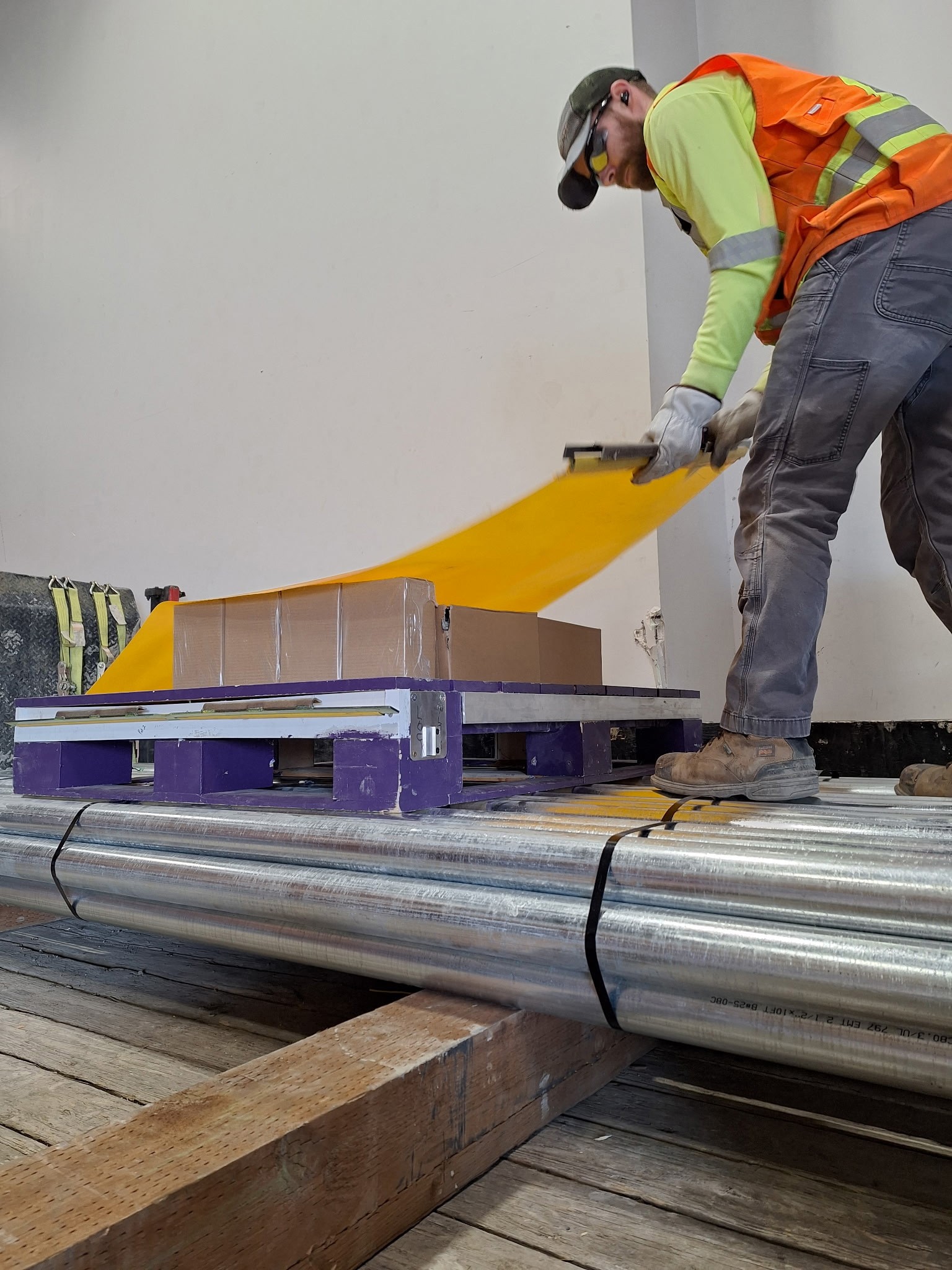
Pallet Industry Dominance


The $112.25 Billion Food Safety Theater: When "Hygienic" Pallets Still Need Dirty Wrap
Future Market's $112.25B projection is driven by F&B sector (38% share) demanding hygienic pallets while accepting unvalidated stretch wrap touching food products. DS Smith's €6M sustainable corrugated investment and Smurfit-WestRock's mega-merger both produce pallets that still require plastic wrapping.
Published By:
Fortune Business Insights
The Food & Beverage Dominance Story
Future Market Insights projects the global pallets market will reach $112.25 billion by 2035, growing at 5.3% CAGR from $66.97 billion in 2025. The research reveals a critical insight:
"The food & beverage industry is the largest end-use sector, accounting for 38% of market share, as pallets are extensively used for handling, storage, and transportation of perishable products."
The F&B sector demands pallets with:
Hygienic features
Pest-proof construction
Easy-to-clean surfaces
Food safety compliance
But examine what this sector-leading 38% market share actually represents.
The €6 Million Corrugated Investment
Research highlights DS Smith's May 2024 move: "DS Smith Plc invested €6 million to enhance its La Chevrolière packaging facility near Nantes, adding a new workshop for producing corrugated cardboard pallets."
What €6 Million Buys:
New production facility for corrugated pallets
Sustainable alternative to wood and plastic
Lightweight, recyclable material
Lower carbon footprint than traditional pallets
What €6 Million Doesn't Address:
Every corrugated pallet still wrapped in plastic
Lightweight pallets enabling more trips = more wrap consumption
Sustainable platform carrying products in disposable packaging
Carbon savings from pallet offset by wrap emissions
You're investing millions in sustainable pallet production while every pallet enables single-use plastic consumption.
The Vilsund Blue Partnership Reality
Research notes DS Smith's December 2024 partnership: "DS Smith partnered with Vilsund Blue, a Danish seafood producer, to replace plastic pallets with fiber-based corrugated alternatives, aimed at reducing CO₂ emissions and enhancing sustainability in seafood packaging."
Partnership Goals:
Replace plastic pallets with fiber-based alternatives
Reduce CO₂ emissions
Enhance sustainability in seafood packaging
Let's Calculate The Real Environmental Impact:
Environmental Component | Before Partnership | After Partnership | Actual Change |
|---|---|---|---|
Pallet material | Plastic (petroleum-based) | Fiber-based corrugated | Improved ✓ |
Pallet CO₂ emissions | Higher | Lower | Reduced ✓ |
Stretch wrap material | Petroleum-based plastic | Petroleum-based plastic | Unchanged ✗ |
Wrap CO₂ emissions | Generated every trip | Generated every trip | Unchanged ✗ |
Total system sustainability | Partial | Partial | Incomplete |
What Partnership Achieves:
Seafood transported on sustainable fiber pallets
Lower carbon footprint from pallet production
Recyclable pallet material
ESG compliance improvement
What Partnership Ignores:
Seafood (requiring maximum hygiene) wrapped in stretch film
Stretch film touching every seafood package
Single-use plastic in direct contact with food products
Carbon emissions from continuous wrap manufacturing
A Danish seafood producer concerned enough about sustainability to switch pallet material still accepts stretch wrap touching every product heading to human consumption.
The Smurfit WestRock Mega-Merger
Research highlights the July 2024 industry consolidation: "Smurfit Kappa Group merged with WestRock, forming Smurfit WestRock, strengthening its global presence and capabilities in sustainable packaging solutions."
Merger Creates:
Combined global footprint
Enhanced sustainable packaging capabilities
Increased market power
Consolidated production capacity
Scale Of Combined Operations:
Multi-billion dollar entity
Facilities across multiple continents
Massive pallet and packaging production
Industry-leading sustainability programs
What Industry Consolidation Delivers:
Benefit | Impact | What It Doesn't Change |
|---|---|---|
Economy of scale | Lower pallet costs | Every pallet still needs wrap |
Global reach | Wider distribution | Every distribution uses disposables |
Sustainable materials | Better pallet options | Wrap remains unsustainable |
R&D investment | Innovation funding | Innovation focuses on pallets, not wrapping |
The largest sustainable packaging merger in history creates a company that produces reusable platforms enabling single-use plastic consumption.
The RFID "Intelligence" Investment
Research emphasizes: "Technological advancements, including RFID-enabled intelligent pallets, are playing a key role in improving tracking, inventory management, and operational efficiency."
What "Intelligent Pallets" Track:
Real-time location data
Inventory levels
Temperature conditions
Usage cycles
Maintenance needs
RFID Investment Structure:
Component | Cost Per Implementation | What It Enables |
|---|---|---|
RFID chips | $0.05-0.15 per pallet | Tracking pallets that need wrapping |
Reader infrastructure | $2,000-5,000 per location | Monitoring wrapped loads |
Software systems | $100,000-500,000 enterprise-wide | Managing consumable assets |
Data analytics | $1,000-5,000/month ongoing | Optimizing consumption efficiency |
What Intelligence Delivers:
Perfect visibility into pallet location
Optimized inventory management
Reduced asset loss
Improved operational efficiency
What Intelligence Doesn't Deliver:
Data on stretch wrap consumption
Analytics on single-use plastic waste
Tracking of disposable material costs
Visibility into total packaging environmental impact
You're embedding intelligence in pallets to track efficient consumption, not to question whether the consumption should exist.
The Third-Party Logistics Acceleration
Research notes: "The growing adoption of third-party logistics (3PL) and warehouse automation across industries is fueling further demand for advanced pallet systems."
3PL Growth Drivers:
E-commerce expansion requiring fulfillment
Companies outsourcing logistics operations
Need for specialized supply chain expertise
Warehouse automation investments
What 3PL Adoption Means:
More centralized distribution
Higher pallet utilization rates
Increased shipping volumes
Optimized logistics networks
The 3PL Consumption Multiplier:
3PL Function | Efficiency Gain | Consumption Impact |
|---|---|---|
Consolidated warehousing | 25% space reduction | 25% more throughput = 25% more wrap |
Optimized routing | 15% fuel savings | 15% more deliveries = 15% more wrap |
Automated handling | 30% labor reduction | 30% faster processing = 30% more wrap |
Net effect | Operational efficiency ↑ | Consumption acceleration ↑ |
3PLs optimize logistics efficiency. This enables more shipments. More shipments means more stretch wrap consumption.
You're professionalizing the supply chain to accelerate consumption.
The Food Safety Requirement Contradiction
Research emphasizes F&B sector dominance because: "To meet food safety standards, pallets with hygienic, pest-proof, and easy-to-clean features are increasingly required."
Food Safety Requirements:
No bacterial harboring
Pest-proof construction
Easy sanitization
Chemical-free contact surfaces
Validated cleaning procedures
What F&B Sector Validates:
Component | Validation Required | Status |
|---|---|---|
Pallet material | FDA food-contact approval | Validated ✓ |
Pallet manufacturing | GMP compliance | Validated ✓ |
Pallet cleaning | Documented procedures | Validated ✓ |
Pallet reuse | Between-use sterilization | Validated ✓ |
Stretch wrap material | Food safety compliance | Assumed ✗ |
Wrap contamination | Between manufacture and use | Unmonitored ✗ |
Wrap-to-food contact | Migration testing | Rarely tested ✗ |
The Logic Gap:
Wooden pallets: Harboring bacteria → Unacceptable
Plastic pallets: Easy to sterilize → Required
Stretch wrap: Unsterilized, touches every product → Accepted
If food safety requires validated, cleanable pallets, why does it accept unvalidated, single-use wrap?
The Perishable Products Paradox
Research notes F&B sector's specific concern: "As global food trade and e-commerce continue to rise, manufacturers are investing in more effective pallet systems to improve supply chain efficiency and minimize product damage."
Perishable Product Priorities:
Temperature control (cold chain integrity)
Contamination prevention (hygiene)
Physical protection (damage prevention)
Speed to market (freshness)
Investment Focus:
Advanced pallet materials
Temperature-monitoring systems
Rapid handling equipment
Cold storage infrastructure
What Gets Prioritized:
Priority | Investment Area | Implementation |
|---|---|---|
Temperature control | Cold-chain pallets | Validated throughout |
Contamination prevention | Cleanable pallet surfaces | Validated throughout |
Physical protection | Structural pallet integrity | Validated throughout |
Speed to market | Logistics optimization | Validated throughout |
Packaging hygiene | Stretch wrap cleanliness | Not validated |
You're investing in sophisticated temperature control and contamination prevention while wrapping products in unmonitored plastic film.
The Global Food Trade Acceleration
Research projects growth driven by: "As global food trade and e-commerce continue to rise..."
Global Food Trade Growth:
Cross-border food shipments increasing
International quality standards tightening
Consumer demand for diverse products rising
Supply chains becoming more complex
What Rising Trade Means:
Trade Metric | Growth Impact | Consumption Implication |
|---|---|---|
Cross-border shipments | More international pallets | More ISPM-15 certified pallets wrapped in plastic |
Quality standards | Stricter pallet requirements | More hygienic pallets wrapped in plastic |
Product diversity | Specialized pallet needs | More custom pallets wrapped in plastic |
Supply chain complexity | More handling touchpoints | More opportunities for wrap damage/replacement |
Global food trade growth accelerates demand for hygienic pallets. Every hygienic pallet gets wrapped in plastic. More trade = more plastic waste.
The E-Commerce Fresh Food Surge
Research highlights e-commerce impact on F&B sector demand.
E-Commerce Food Trends:
Grocery delivery services expanding
Meal kit subscriptions growing
Direct-to-consumer perishables increasing
Last-mile cold chain requirements rising
E-Commerce Food Logistics:
Delivery Model | Pallet Requirement | Wrap Consumption |
|---|---|---|
Grocery delivery | Hygienic pallets for multiple product types | High (mixed loads, frequent wrapping) |
Meal kits | Temperature-controlled pallets | High (premium packaging, extra protection) |
Direct-to-consumer | Small-batch specialized pallets | Highest (individual orders, more wrapping per unit) |
E-commerce fresh food creates the most demanding pallet requirements—and the highest stretch wrap consumption per delivered unit.
The Supply Chain Efficiency Trap
Research notes manufacturers "investing in more effective pallet systems to improve supply chain efficiency."
Efficiency Investments:
Faster handling equipment
Automated storage systems
Optimized routing software
Real-time tracking technology
What Efficiency Delivers:
Metric | Before Optimization | After Optimization | Change |
|---|---|---|---|
Pallet throughput | 100 pallets/day | 150 pallets/day | +50% |
Handling time | 3 minutes per pallet | 2 minutes per pallet | -33% |
Labor per pallet | 2 workers | 1 worker | -50% |
Stretch wrap per pallet | 1 roll | 1 roll | 0% |
Daily wrap consumption | 100 rolls | 150 rolls | +50% |
Supply chain efficiency accelerates pallet movement. Faster movement enables more volume. More volume consumes more stretch wrap.
Efficiency investments increase consumption velocity.
The "Minimize Product Damage" Focus
Research emphasizes manufacturers investing to "minimize product damage."
Damage Prevention Strategies:
Stronger pallet construction
Better load distribution
Improved handling equipment
Protective packaging layers
What "Protection" Means:
Protection Method | Function | Material Used |
|---|---|---|
Structural pallet | Load support | Wood/plastic (reusable) |
Corner protectors | Edge reinforcement | Cardboard/foam (often reusable) |
Top sheets | Moisture barrier | Plastic (sometimes reusable) |
Stretch wrap | Load containment | Plastic film (always single-use) |
The only component that's always single-use is the one that touches every product.
The $112.25 Billion Food Safety Investment
Future Market Insights projects $112.25 billion market value by 2035, with F&B sector commanding 38% share due to:
Hygienic pallet requirements
Food safety compliance
Perishable product handling
Global food trade growth
E-commerce fresh food expansion
What $42.66 Billion F&B Pallet Market Measures:
Annual spending on food-grade pallets
Investment in hygienic platforms
Compliance with safety regulations
Prevention of contamination from pallets
What $42.66 Billion Doesn't Include:
Stretch wrap consumed on every food-grade pallet
Single-use plastic touching every food product
Environmental cost of continuous wrap disposal
Health implications of unvalidated wrap-to-food contact
The sector most concerned about food safety spends billions on hygienic platforms while accepting unvalidated plastic wrapping every load.
The PEER Pallets Food Safety Reality
Future Market Insights identifies what drives the $112.25 billion market:
Hygienic features (non-porous, cleanable)
Food safety compliance (FDA-approved materials)
Perishable handling (temperature resistance)
Damage prevention (structural integrity)
Global trade ready (ISPM-15, cross-border compliance)
PEER Pallets delivers all these requirements—then eliminates the contamination source others ignore:
Food Safety Requirement | Industry Standard | PEER Pallets Advantage |
|---|---|---|
Hygienic pallet surface | Cleanable plastic/fiber pallets + unsterilized stretch wrap | Cleanable pallet + cleanable reusable wrap |
Food contact validation | Pallet materials validated + wrap materials assumed | Complete system validated for food contact |
Contamination prevention | Sterilized pallet + unmonitored wrap | Sterilized pallet + sterilized integrated wrap |
Temperature control | Cold-chain pallets + insulated wrap | Cold-chain pallet + reusable temperature-rated wrap |
Damage prevention | Structural integrity + protective film | Structural integrity + integrated protection system |
We don't just meet food safety standards for the pallet. We meet them for the entire load securement system.
The Bottom Line
Research projects $112.25 billion in pallets market value by 2035, with F&B sector commanding 38% share ($42.66 billion) due to stringent hygiene and safety requirements.
But examine what "food safety" actually means in current practice:
Hygienic pallets (validated and cleanable)
Food-grade materials (tested and approved)
Contamination prevention (documented and enforced)
Stretch wrap (assumed safe, rarely tested, never sterilized between production and use)
The Investment Pattern:
€6 million in sustainable corrugated pallets → still wrapped in plastic
Smurfit WestRock merger creating sustainability giant → producing wrap-dependent pallets
RFID intelligence tracking assets → that consume disposables
3PL automation accelerating operations → that generate waste faster
The food & beverage sector leads pallet market spending because food safety is paramount. Yet this same sector accepts single-use plastic wrapping every product without the validation it requires for pallets.
PEER Pallets doesn't ask the food industry to compromise safety for sustainability. We deliver both: hygienic, food-grade, integrated solutions that eliminate single-use plastic consumption.
That's not food safety theater. That's actual food safety—for both products and planet.
Ready to stop accepting unvalidated plastic touching your food products? Contact PEER Pallets to learn how our integrated system delivers complete food safety without the $112.25 billion in consumption costs.