Plastic Pallet Market


The $13.55 Billion "Sustainable" Plastic Pallet Illusion
Straits Research's $13.55B projection represents premium pricing ($20-25 vs. $8-10 for wood) for "sustainable" platforms wrapped in petroleum-based film. The industry celebrates 90% recycled plastic content while every pallet enables single-use plastic consumption.
Published By:
Fortune Business Insights
The Premium Sustainability Claim
Straits Research projects the plastic pallet market will reach $13.55 billion by 2033, growing at 5.4% CAGR. The industry positions plastic pallets as the sustainable alternative to wood:
90% made from recycled plastic
HDPE material is recyclable
Lighter weight reduces transportation fuel
Longer lifespan (10+ years vs. 3-5 years for wood)
No forest harvesting required
But examine what this "sustainability" actually delivers.
The $20-25 Price Premium Nobody Questions
Research reveals the cost structure that the industry doesn't emphasize:
Price Comparison (48"×40" GMA pallet):
Pallet Type | New Price | Recycled/Used Price | Premium Over Wood |
|---|---|---|---|
Wood pallet | $8-10 | $4-5 | Baseline |
Plastic pallet | $20-25 | N/A (reusable model) | 150-250% more |
Industry justifies this premium through:
Longer lifespan (10 years vs. 3-5 years)
No repair costs
Weight savings in transportation
Hygiene and chemical resistance
Sustainability benefits
But notice what the calculation ignores: every plastic pallet still requires stretch wrap on every single trip.
The Petroleum-Based "Recycled" Reality
Research notes "around 90% of pallets are manufactured with recycled plastic, primarily high-density polyethylene (HDPE)."
This sounds environmentally responsible. But consider the full picture:
Material Sourcing Chain:
Base material: HDPE derived from petroleum
Recycled content: Post-industrial scrap, used pallets
Alternative materials: Rubber, silicates, polypropylene (also petroleum-based)
What "90% Recycled" Means:
Original material still came from fossil fuels
Recycling extends material life but doesn't eliminate petroleum dependency
Each pallet contains 10% virgin petroleum-based plastic
At end of life, material enters recycling stream (if infrastructure exists)
What "90% Recycled" Doesn't Change:
Every pallet wrapped in petroleum-based stretch film every trip
New petroleum extraction for stretch wrap continues
Single-use plastic waste generation persists
Carbon footprint includes both pallet and wrap
You're buying a recycled petroleum product to transport goods wrapped in new petroleum products.
The Weight Savings Calculation Fraud
Industry celebrates that "a standard wood pallet weighs around 80 pounds, while a comparable plastic pallet weighs less than 50 pounds."
Claimed Transportation Savings:
30-pound weight reduction per pallet
Lower fuel consumption
Reduced transportation costs
Decreased carbon emissions
But this calculation is deliberately incomplete:
Actual Weight Analysis (50 pallets in transport):
Component | Wood Pallet System | Plastic Pallet System | Savings Claimed |
|---|---|---|---|
Pallets | 4,000 lbs (80 × 50) | 2,500 lbs (50 × 50) | 1,500 lbs ✓ |
Stretch wrap | 150 lbs (3 lbs × 50) | 150 lbs (3 lbs × 50) | 0 lbs ✗ |
Total packaging | 4,150 lbs | 2,650 lbs | 1,500 lbs |
What The Industry Ignores:
Stretch wrap weight is identical for both systems
Fuel savings calculation accurate only for pallet weight
No calculation includes environmental cost of producing stretch wrap
Weight savings don't address waste generation
You're optimizing weight of one component while ignoring weight and waste of another.
The HDPE Dominance Contradiction
Research shows "HDPE is the largest segment and expected to grow at 5.9% CAGR" because:
Exceptionally durable with high impact resistance
Minimal damage from rough forklift handling
Weather and chemical resistant
Suitable for pharmaceutical and food applications
HDPE Properties:
Benefit | Industry Claim | Reality Check |
|---|---|---|
Impact resistance | "Sustains little or no damage from rough handling" | Pallet survives; still needs stretch wrap |
Chemical resistance | "Resistant to weather and chemicals" | Pallet resists contamination; stretch wrap doesn't |
Durability | "10+ year lifespan" | Pallet lasts decade; generates 10 years of stretch wrap waste |
Every HDPE benefit addresses pallet performance. None address the single-use plastic consumed on every trip the pallet makes.
The Hygiene Claim Hypocrisy
Research emphasizes plastic pallets for pharmaceuticals because "wooden pallets pose high risk of harboring bacteria, pests, or fungi."
Real Industry Examples Cited:
Johnson & Johnson (2008): Tylenol contaminated by chemical in wooden pallet preservative
Pfizer (2010): Lipitor showed odor from wooden pallet treatment
Industry response: Switch to plastic pallets with:
Non-porous surfaces
No bacterial harboring
Easy cleaning and sterilization
No chemical treatments required
The Contamination Source Nobody Addresses:
Contamination Risk | Wood Pallet + Stretch Wrap | Plastic Pallet + Stretch Wrap |
|---|---|---|
From pallet surface | High (bacteria, chemicals) | Eliminated ✓ |
From stretch wrap | Present | Present ✗ |
Between uses | Pallet contaminated | Pallet cleaned ✓ |
Stretch wrap reuse | Never reused | Never reused ✗ |
The Logic Gap:
Wood pallets: Contamination risk is unacceptable → Switch to plastic
Stretch wrap: Contamination risk is... ignored?
If single-use wooden pallets create contamination risk, why do single-use plastic wraps not create the same concern?
The Johnson & Johnson Example
Research details how J&J received complaints about "moldy and musty odor" in Tylenol, traced to "chemical used to preserve wooden pallets."
Industry learned: Don't use pallets that require chemical preservatives.
What Industry Didn't Learn:
Every J&J pallet (plastic or wood) still wrapped in plastic
Chemical preservatives eliminated from pallets
Chemical plasticizers present in every stretch wrap
You solved contamination from pallet preservatives by switching to pallets that require preservative plastic wraps.
The Nestable Pallet Efficiency Trap
Research shows "nestable pallets account for largest market share" because:
Can nest inside each other
Less space during return freight
More cost-effective than other types
Lower raw material requirements
Less expensive than rackable/stackable
Why Nestable Design Exists:
Problem Nestable Pallets Solve | Root Cause Nobody Questions |
|---|---|
Return freight costs high | Why are pallets returning empty? |
Storage space needed for empties | Why do we need empty pallet storage? |
Transportation waste | Why are we transporting empty assets? |
The Nested Logic:
20 nested pallets occupy space of 3 regular pallets
Reduces return logistics costs by 85%
Improves warehouse space efficiency
The Question Nobody Asks:
Why are pallets circulating empty instead of staying with products as integrated assets?
Nestable pallets optimize an inefficient system. They don't question why the system requires constant pallet circulation.
The Rackable Pallet "Heavy-Duty" Investment
Research notes "rackable pallets are fastest-growing segment" due to:
Higher strength than stackable/nestable
Ideal for heavy-duty applications
Easy cleaning with pressurized water
Highly durable rigid structure
Growing adoption of reusable pallets
Investment Justification:
Premium pricing for heavy-duty applications
Longer lifespan offsets higher cost
Structural integrity for automation compatibility
What Heavy-Duty Delivers:
Pallet that survives heavy loads
Structure that withstands rough handling
Platform that lasts multiple years
What Heavy-Duty Doesn't Deliver:
Heavy loads still wrapped in stretch film
Durable pallets still consume disposables
Long-lasting platforms still generate short-term waste
You're engineering advanced structures to carry products wrapped in materials you'll discard at destination.
The Polypropylene "Sustainability" Growth
Research projects polypropylene as "fastest-growing segment" driven by:
"Firms using returnable pallets to decrease plastic waste"
Addressing "sustainability issues of expendable pallets"
Heavy-duty applications requiring superior strength
The Returnable Pallet Logic:
Industry Narrative | Actual Implementation |
|---|---|
"Decrease plastic waste" | Pallet is reusable; wrap is still disposable |
"Sustainability issues" | Addresses pallet replacement; ignores wrap consumption |
"Returnable system" | Pallet returns; wrap never does |
Polypropylene pallets return and reuse. Stretch wrap wraps and wastes.
The Food & Beverage Dominance Data
Research shows F&B "dominates market with 5.9% CAGR" due to:
Changing lifestyles and convenience
Expanding processed food industry
Ready-to-eat meals growth
Cold chain logistics requirements
Cold Chain Example: US providers using plastic pallets extensively:
Americold Logistics
Burris Logistics
Lineage Logistics
US Cold Storage
Why F&B Chooses Plastic:
Hygiene requirements (no bacterial growth)
Temperature resistance (-20°C to 40°C)
Easy cleaning and sterilization
No chemical treatments
What F&B Still Accepts:
Stretch wrap on every temperature-controlled shipment
Single-use plastic touching every food product
Disposable material in contact with items headed to human consumption
The sector most concerned about contamination accepts unsterilized single-use plastic wrapping every load.
The Chemical Industry "Preference Shift"
Research notes chemicals shifting from wood to plastic because "in the last decade chemical companies increasingly preferred plastic pallets due to durability, sustainability, and hygiene."
Chemical Industry Logic:
Material Handled | Contamination Risk | Solution Adopted |
|---|---|---|
Hazardous chemicals | Wooden pallets absorb chemicals | Switch to plastic pallets ✓ |
Plastic resins | Need clean, non-porous surface | Plastic pallets ✓ |
Industrial compounds | Require chemical resistance | Plastic pallets ✓ |
All chemicals | Wrapped in plastic every shipment | Stretch wrap (unaddressed) |
Chemical companies produce the raw materials for both plastic pallets and stretch wrap. They've optimized the durable component while continuing to manufacture and consume the disposable component.
The Pharmaceutical Contamination Contradiction
Research emphasizes pharma growth due to:
Rising aging population
Increasing chronic disease prevalence
Growing health awareness
Expanding generic drug production
Pharma's Plastic Pallet Requirements:
Contamination-free surfaces
Easy sterilization
Chemical resistance
Temperature stability
No bacterial harboring
What Pharma Validates:
Pallet materials (FDA-approved HDPE)
Pallet manufacturing (GMP compliance)
Cleaning procedures (documented protocols)
Reuse cycles (validated between uses)
What Pharma Doesn't Validate:
Stretch wrap material composition (rarely tested)
Wrap contamination between manufacturing and use (unmonitored)
Microbial growth on wrap during storage (not tracked)
Chemical migration from wrap to products (assumed safe)
An industry that validates everything accepts unvalidated single-use plastic touching every product.
The $8-10 vs. $20-25 Calculation
Research acknowledges: "wood pallets are approximately 33% less expensive than plastic pallets."
Industry justifies premium through lifecycle analysis:
Traditional Comparison (5 years):
Cost Component | Wood Pallets | Plastic Pallets |
|---|---|---|
Initial purchase | $8-10 each | $20-25 each |
Repairs (5 repairs) | $75-125 | $0 |
Replacement (2 replacements) | $16-20 | $0 |
Total 5-year cost | $99-155 | $20-25 |
Stretch wrap (5 years, 100 trips) | $3,000+ | $3,000+ |
Actual total | $3,099-3,155 | $3,020-3,025 |
The industry compares pallet costs while both systems consume identical stretch wrap amounts.
The Asia-Pacific "Manufacturing Hub" Growth
Research shows Asia-Pacific dominates with 32.6% share, growing at 6.7% CAGR due to:
Trans-Pacific Partnership manufacturing hub
Free trade agreements
Strengthened trade and manufacturing sectors
What This Growth Represents:
Increased industrial production
Expanded export activities
Growing logistics infrastructure
What This Growth Consumes:
Millions of plastic pallets manufactured annually
Billions of feet of stretch wrap
Massive petroleum-based plastic production
Continuous waste generation in regions with limited recycling
The fastest-growing region is consuming the most "sustainable" solution while generating the most waste.
The North America NAFTA/USMCA Impact
Research notes North America growth driven by:
NAFTA and USMCA trade agreements
Robust manufacturing industry
Trade between US, Canada, Mexico
Trade Agreement Impact:
Agreement Benefit | Logistics Implication | Consumption Reality |
|---|---|---|
Increased cross-border trade | More pallet trips | More stretch wrap used |
Reduced trade barriers | Higher shipping volumes | Higher plastic waste |
Manufacturing integration | Optimized supply chains | Optimized consumption |
Free trade agreements accelerate movement of goods wrapped in single-use plastic.
The EU Sustainability Roadmap Irony
Research highlights Europe's position: "European Commission published new roadmap for sustainability in EU economy (December 2019), pushing end-use industries to adopt green packaging, including reusable plastic pallets."
EU Sustainability Focus:
Environmental, economic, social dimensions
Green packaging mandates
Reusable plastic pallets encouraged
Closed-loop pallet systems promoted
What EU Promotes:
Reusable pallets ✓
Recycled plastic ✓
Circular economy ✓
Sustainable development ✓
What EU Roadmap Doesn't Address:
Single-use stretch wrap on every reusable pallet
Petroleum-based plastic consumption for wrapping
Waste generation from "sustainable" system
Carbon footprint of continuous wrap manufacturing
Europe mandates reusable pallets while accepting disposable wrapping.
The "Closed-Loop" System That Isn't
Research notes European market "expected to benefit from spiked plastic recycling activities by pallet producers to promote closed-loop pallet system."
Closed-Loop Claim:
Pallets manufactured from recycled plastic
Used pallets collected after lifecycle
Recycled into new pallets
System closes the loop
What's Actually Closed:
Pallet material: Plastic → Use → Recycle → New Pallet (closed) ✓
What's Not Closed:
Stretch wrap: Petroleum → Manufacture → Single Use → Waste (linear) ✗
You have a closed loop for one component supporting an open system for another.
The CABKA & Renewi "Eco CP3 Pallet"
Research highlights September 2025 launch: "Cabka and Renewi introduced Eco CP3 Pallet, designed to advance plastics circularity."
Innovation Claims:
Circular economy advancement
Recycling specialist collaboration
Sustainability improvement
What Innovation Delivers:
Better pallet recyclability
Improved material recovery
Enhanced circular credentials
What Innovation Doesn't Deliver:
Solution for stretch wrap waste
Elimination of single-use packaging
Circular system for complete load securement
Even the latest "circular economy" innovations focus on pallet circularity while ignoring wrap linearity.
The EcoVadis Platinum Medal Achievement
Research notes "Cabka improved EcoVadis sustainability rating from 72 to 82, placing it in top 1% of rated companies worldwide."
Sustainability Measurement:
Category Measured | Cabka Performance | Category Not Measured |
|---|---|---|
Pallet material sourcing | Top 1% | Stretch wrap material sourcing |
Manufacturing practices | Top 1% | Wrap manufacturing emissions |
Recycling programs | Top 1% | Wrap disposal/waste |
Circular economy | Top 1% | Wrap linear economy |
ESG ratings measure pallet sustainability while the system generates disposable plastic waste with every pallet use.
The ORBIS ProMat 2025 Automation Focus
Research highlights ORBIS showcasing "reusable packaging solutions suited for automated systems (robotics, AGVs) at ProMat 2025."
Automation Integration:
Compatible with robotic systems
Works with AGVs (automated guided vehicles)
Optimized for automated warehouses
Streamlined for high-speed operations
What Automation Optimizes:
Pallet handling speed
Warehouse throughput
Labor efficiency
System integration
What Automation Doesn't Change:
Automated pallets still wrapped manually or with wrapping machines
Robotic handling of stretch-wrapped loads
High-speed movement of disposable packaging
Efficient processing of waste generation
You're automating the handling of pallets that still require manual wrapping or dedicated wrapping equipment.
The Greenville, Texas Manufacturing Expansion
Research notes "ORBIS opened new facility in Greenville, TX with phased installation of 16 presses in 2025."
Capacity Expansion:
16 new injection molding presses
Increased manufacturing capacity
Growing production volume
Meeting rising demand
What Increased Capacity Delivers:
More plastic pallets manufactured
Greater market supply
Higher industry volume
What Increased Capacity Means:
More pallets requiring stretch wrap
Increased stretch wrap consumption
Growing single-use plastic waste
Accelerated disposable material production
Manufacturing capacity grows to produce reusable pallets that enable single-use plastic consumption.
The $13.55 Billion Sustainability Premium
Straits Research projects $13.55 billion market value by 2033, driven by:
Lightweight design reducing fuel consumption
Recycled material content (90%)
Durability extending lifecycle
Hygiene advantages over wood
Sustainability benefits
What This Market Measures:
Premium pricing for "sustainable" pallets
Investment in recycled plastic manufacturing
Spending on durable assets
Value of hygiene advantages
What This Market Doesn't Measure:
Stretch wrap consumed on every sustainable pallet
Petroleum extraction for wrap production
Single-use plastic waste generated
True total cost including consumables
You're paying premium prices for sustainable platforms that carry products wrapped in disposables.
The PEER Pallets Position
Straits Research identifies what drives the $13.55 billion plastic pallet market:
Sustainability (90% recycled content, recyclable)
Hygiene (non-porous, cleanable, bacteria-resistant)
Durability (10+ year lifespan, no repairs)
Weight savings (37.5% lighter than wood)
Chemical resistance (safe for pharmaceutical/food use)
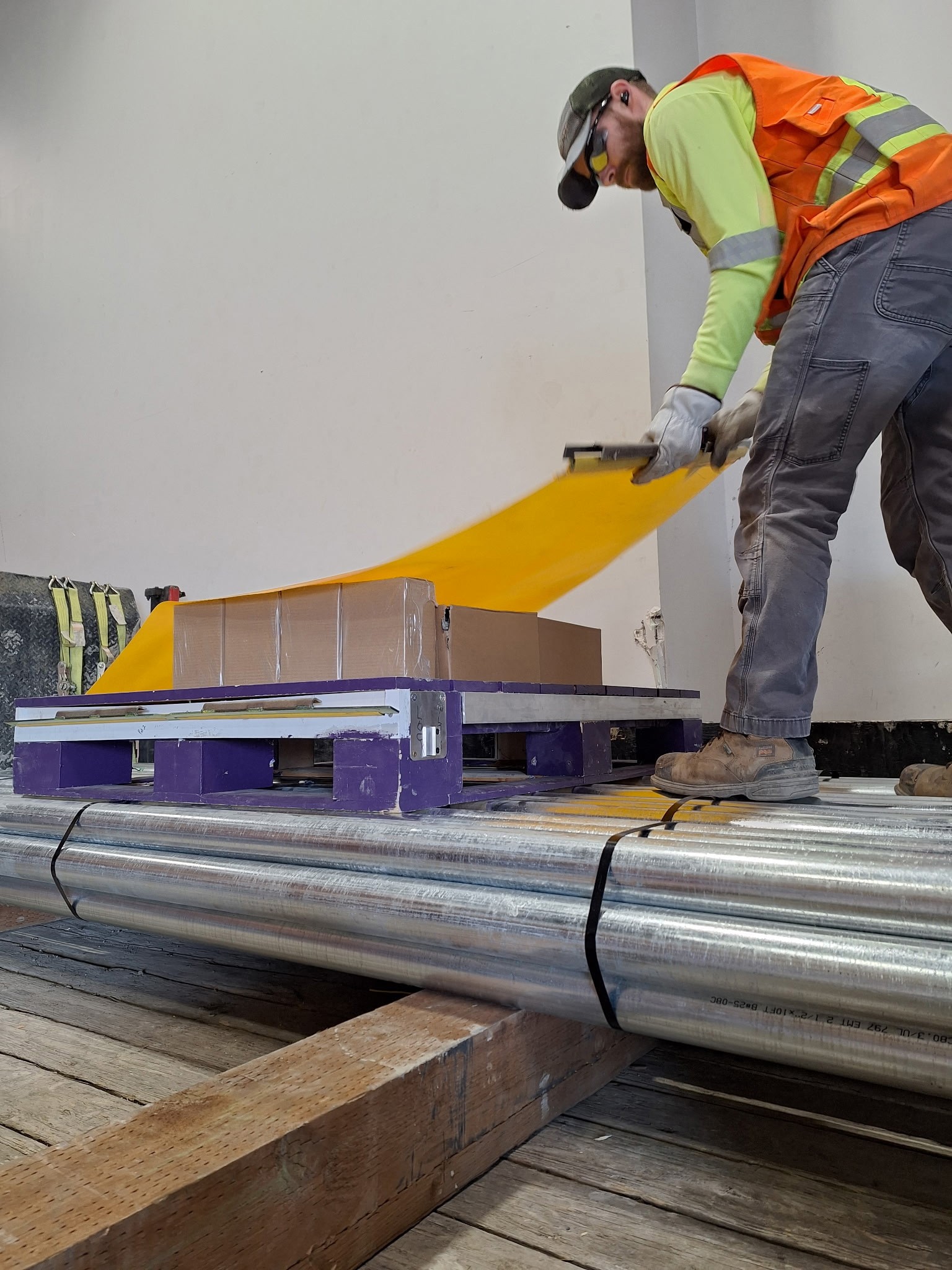
PEER Pallets delivers all these benefits—then eliminates what they enable:
Market Driver | Plastic Pallet Industry | PEER Pallets Difference |
|---|---|---|
Sustainability | Recycled plastic pallet + petroleum-based wrap | HDPE pallet + integrated reusable wrap (zero stretch wrap) |
Hygiene | Cleanable pallet + unvalidated single-use wrap | Cleanable pallet + cleanable reusable wrap |
Durability | 10-year pallet + continuous wrap consumption | 10-year pallet + 10-year integrated wrapping system |
Weight savings | 30-lb lighter pallet + 3-lb stretch wrap per trip | 30-lb lighter pallet + reusable wrap (one-time weight) |
Chemical resistance | Resistant pallet + chemical-laden stretch film | Resistant pallet + resistant reusable wrap |
We match every plastic pallet advantage. Then we eliminate the consumption that plastic pallets enable.
The Bottom Line
Research projects $13.55 billion in plastic pallet market value by 2033, celebrating:
90% recycled plastic content
10+ year lifespan durability
Weight and fuel savings
Hygiene and safety benefits
Sustainability advantages over wood
But examine what "sustainability" means:
Recycled petroleum product (still petroleum-based)
Durable platform (that enables disposable packaging consumption)
Weight savings (only calculating pallet, ignoring wrap)
Hygiene benefits (on pallet surface, ignoring wrap contamination)
Premium pricing (not including stretch wrap operational costs)
The plastic pallet industry convinced the market to pay 150-250% more for a pallet by claiming sustainability—while every single one still gets wrapped in petroleum-based single-use plastic.
PEER Pallets doesn't ask you to pay a sustainability premium. We deliver actual sustainability: reusable platform with reusable wrapping system.
That's not premium pricing for partial solutions. That's complete elimination of consumption.
Ready to stop paying premium prices for "sustainable" pallets that still require disposable wrap? Contact PEER Pallets to learn how our integrated system delivers true sustainability without the $13.55 billion in consumption costs.