Global Plastic Waste


The Global Plastic Crisis: Why the Logistics Industry Can't Ignore UNEP's Latest Findings
UNEP data shows 430M tonnes of annual plastic production (300M becoming waste), with only 9% ever recycled and 36% going to packaging. The logistics industry wraps "sustainable" pallets in plastic that breaks down into microplastics now found in human bloodstreams, placentas, and breast milk.
Published By:
Fortune Business Insights
The Scale of the Problem
Humanity produces more than 430 million tonnes of plastic annually. Two-thirds of it becomes waste almost immediately. But here's what most businesses in the logistics sector don't realize: their daily operations are directly contributing to one of the planet's most urgent environmental crises.
The United Nations Environment Programme (UNEP) has released sobering data that should concern every company that wraps pallets, ships products, or manages supply chains.
The Numbers Don't Lie
Global Plastic Crisis | Annual Impact |
|---|---|
Total plastic production | 430+ million tonnes |
Plastic leaking into aquatic ecosystems | 19-23 million tonnes |
Plastic entering oceans | 11+ million tonnes |
Greenhouse gas emissions from plastics (2019) | 1.8 billion metric tonnes (3.4% of global total) |
But the real crisis isn't just what's happening now. It's what's coming.
A Problem Accelerating Out of Control
UNEP's research reveals a terrifying trend: plastic production doubled between 2000 and 2019. Under current trajectories, it's forecast to triple by 2060.
Think about what that means for your business. If regulations are struggling to keep pace with current plastic waste, what happens when production triples?
The Recycling Myth Exposed
Here's the uncomfortable truth UNEP confirms: only 9% of all plastic waste ever produced has been recycled. Ever.
What Actually Happens to Plastic Waste | Percentage |
|---|---|
Recycled | 9% |
Incinerated | 12% |
Landfilled | 46% |
Mismanaged/becomes litter | 22% |
Accumulated in environment | 79% total |
The rest? It's in landfills, dumps, or the natural environment. Including the stretch wrap you used yesterday, last week, last year.
The Packaging Sector's Outsized Impact
UNEP identifies packaging as the largest generator of single-use plastic waste in the world. Approximately 36% of all plastics produced are used in packaging.
That includes every roll of stretch wrap. Every pallet wrapped and shipped. Every protective layer that gets cut away and thrown in the garbage at the destination.
The logistics industry isn't just a contributor to this crisis. It's one of the primary drivers.
The Climate Connection Nobody Talks About
Plastic isn't just a waste problem. It's a climate problem.
Over 99% of plastics are produced from fossil fuels—oil, natural gas, and coal. In 2019, plastic production generated 1.8 billion metric tonnes of greenhouse gas emissions. That's 3.4% of the global total.
If current trends continue, by 2050 the plastic industry could account for 20% of the world's total oil consumption.
Every pallet you wrap isn't just creating waste. It's consuming fossil fuels and generating emissions.
The Human Health Crisis Hidden in Plain Sight
UNEP's research confirms what many suspected: plastic doesn't just harm the environment. It harms people.
As plastics break down, they release:
Microplastics into water and food chains
Toxic chemicals and metals
Synthetic fibers that humans ingest through seafood, drinking water, and even salt
The health impacts include hormonal changes, developmental disorders, reproductive abnormalities, and cancer.
Your employees handling stretch wrap daily? They're part of this exposure cycle.
The Economic Costs Are Already Here
Sector | Impact |
|---|---|
Tourism | Negative impacts from coastal plastic pollution |
Fisheries | Contamination and ecosystem disruption |
Aquaculture | Water quality degradation |
Coastal communities | Cleanup costs |
Businesses | Potential liability costs reaching $100 billion by 2040 if required to cover waste management |
UNEP warns that if governments require businesses to cover waste management costs—including recycling—this could amount to $100 billion by 2040.
That's not a future hypothetical. That's a financial risk already being priced into forward-looking business models.
The Regulatory Wave That's Already Breaking
UNEP reports that over 40 countries now have extended producer responsibility (EPR) schemes requiring producers to manage plastic packaging throughout its entire life cycle.
In India alone, more than 45,000 companies have joined EPR initiatives. Technical assistance programs are helping 53 nations better manage plastic waste. Regional policies on single-use plastics are emerging across Southeast Asia.
This isn't coming. It's here.
Why "Better Recycling" Won't Save You
UNEP explicitly warns against attempting to solve the pollution crisis through increased recycling alone.
Why? Because the fundamental economics don't work:
Virgin fossil fuel feedstocks cost less than recycled materials
Plastic waste management remains fragmented and inefficient
Bio-based and "biodegradable" alternatives pose similar chemical threats to conventional plastics
The current linear model—produce, use, discard—is broken. No amount of optimization fixes a fundamentally flawed system.
The Circular Economy Imperative
UNEP and 170+ nations agree: the solution requires a shift to a circular economy for plastics. That means:
Eliminate waste at the source through better design
Keep materials in use as long as possible
Regenerate natural systems instead of depleting them
For the logistics industry, this translates to one clear directive: stop using single-use packaging.
What PEER Pallets Offers in This Context
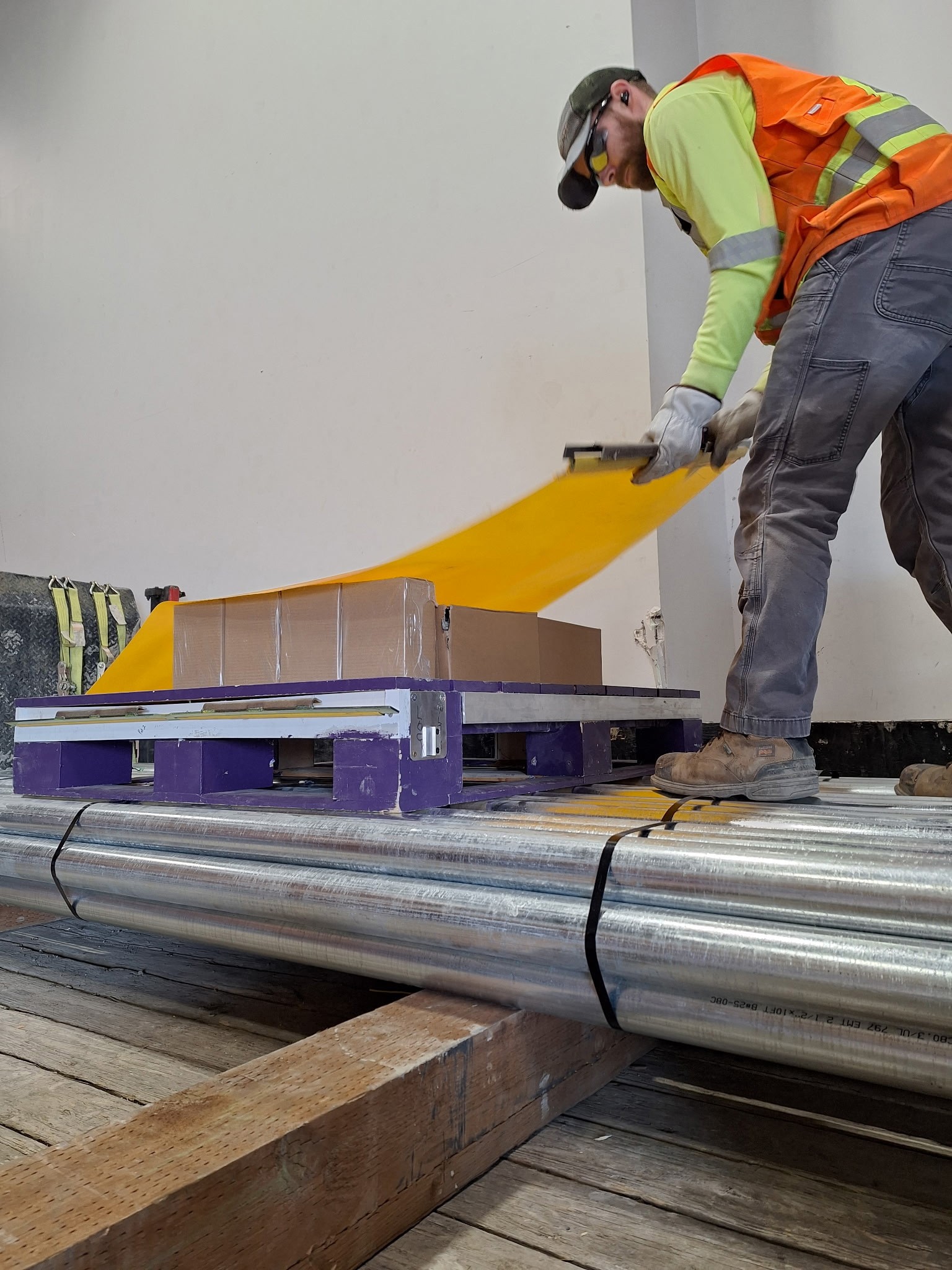
Against UNEP's stark findings, PEER Pallets represents exactly the kind of systemic solution the circular economy demands.
Traditional Approach | PEER Pallets Approach |
|---|---|
Single-use stretch wrap from fossil fuels | Reusable integrated wrapping system |
Contributes to 19-23M tonnes aquatic pollution annually | Zero plastic waste generated |
Part of the 36% packaging waste problem | Eliminates packaging waste entirely |
Creates microplastics and toxic breakdown | Durable HDPE construction, recyclable at end of 10-year life |
Requires continuous petroleum extraction | One-time material investment |
Contributes to climate emissions | Reduces operational carbon footprint |
The 2060 Question
UNEP forecasts plastic production tripling by 2060. But regulations are already tightening in 2026.
The logistics industry faces a choice: adapt proactively or be forced to adapt reactively when regulations make single-use packaging economically or legally impossible.
The Investment Community Is Watching
UNEP reports that 180 investors, banks, and insurers representing $17 trillion in assets have signed the Finance Statement on Plastic Pollution, encouraging countries to agree on a deal to end plastic pollution.
That's not activism. That's risk management. The financial sector recognizes that businesses dependent on single-use plastics face existential regulatory and market risks.
The Intergovernmental Treaty Coming in 2025
In December 2024, over 170 nations agreed to a Chair's Text that will form the basis for renewed negotiations on a legally binding international instrument to end plastic pollution.
As UNEP Executive Director Inger Andersen stated: "It is clear that the world still wants and demands an end to plastic pollution."
The international legal framework is taking shape. The question isn't whether it will impact your business. The question is whether you'll be ready.
The Bottom Line for Logistics Operations
UNEP's data makes one thing clear: the current model is unsustainable environmentally, economically, and regulatorily.
Every company still relying on single-use stretch wrap is:
Contributing to 430+ million tonnes of annual plastic production
Adding to the 19-23 million tonnes polluting aquatic ecosystems
Participating in a system that's forecast to triple by 2060
Exposed to regulatory risks already materializing globally
Facing potential financial liability as EPR schemes expand
A Solution Aligned with Global Mandates
PEER Pallets isn't just a better pallet. It's a response to the exact crisis UNEP is documenting—a shift from linear to circular, from single-use to reusable, from environmental harm to sustainable operations.
The UN data shows the problem. PEER Pallets provides the solution the logistics industry needs to be part of the answer rather than part of the crisis.
Ready to align your operations with the circular economy future? Contact PEER Pallets to learn how eliminating single-use stretch wrap positions your business ahead of the regulatory and market shifts already underway.