Hygiene Requirements

The $10 Billion Hygiene Illusion: Why "Food-Safe" Plastic Pallets Are Still Wrapped in "Do Not Contact Food" Plastic
IMARC projects the global plastic pallets market will hit $10.09B by 2033, with food and beverage leading adoption because plastic is non-porous, FDA-compliant, and easy to sanitize. But every "sanitary" pallet still gets wrapped in industrial stretch film explicitly labeled "Do Not Contact Food"—produced in non-food-grade environments with tackifiers, UV stabilizers, and unvalidated migrants. Hygiene theater ends where the wrap begins.
Published By:
Fortune Business Insights
How the pallet industry built a $10 billion hygiene story that quietly contradicts itself
IMARC Group's latest analysis of the global plastic pallets market tells a clean, confident story: food and beverage is the largest end-use segment, hygiene requirements are driving the shift from wood to plastic, and the market will reach $10.09 billion by 2033 at a 4.42% CAGR.
It's a compelling narrative. It's also incomplete.
Because every one of those hygienic, non-porous, FDA-compliant plastic pallets gets wrapped in something the industry doesn't like to talk about: industrial stretch film that is explicitly not approved for food contact, manufactured in environments that have no food-grade certification, and thrown away after a single use.
What IMARC Actually Found
Metric | Value |
|---|---|
Global plastic pallets market (2024) | USD 6.84 Billion |
Projected market size (2033) | USD 10.09 Billion |
Forecast CAGR (2025–2033) | 4.42% |
Leading material | HDPE |
Leading end-use segment | Food & Beverage |
Primary adoption driver | Hygiene & safety requirements |
The report is explicit about why food and beverage dominates: plastic pallets are non-porous, moisture-resistant, and easy to clean, so they meet food safety regulations. Post-COVID demand has only accelerated the shift as hygiene standards tighten across food processing, pharmaceuticals, and cold chain logistics.
Why Wood Lost This Argument
The regulatory case against wooden pallets in food and pharmaceutical settings is well-documented and, at this point, uncontroversial.
Contamination Risk | Wooden Pallets | HDPE Plastic Pallets |
|---|---|---|
Porous surface absorbs liquids | Yes | No |
Harbors Listeria, Salmonella, E. coli | Documented by FDA and independent labs | Non-porous surface resists pathogens |
Can be steam cleaned or pressure washed | Damages wood, accelerates decay | Yes, without degradation |
Nails and splinters puncture products | Ongoing risk | No fasteners |
Chemical treatment (methyl bromide, formaldehyde) | Standard for export pallets | Not required |
FDA guidance on ready-to-eat food processing areas | Not recommended for wet processing or RTE food areas | Accepted as easily cleanable |
The Food Safety Modernization Act (FSMA), signed into law in 2011, treats pallets as "transportation equipment" and requires them to be designed, maintained, and stored in sanitary conditions. The FDA's own draft guidance on Listeria monocytogenes control recommends against using wooden pallets in areas where ready-to-eat foods are processed or exposed.
Plastic pallets pass this test. They are legitimately safer for food and pharmaceutical applications. That part of the story is true.
The Part Nobody Wants to Discuss
Industrial Stretch Film Is Not Food-Grade — By Design
There are two distinct categories of plastic film in commercial use, and they are not interchangeable.
Attribute | Food-Grade Cling Film | Industrial Pallet Stretch Wrap |
|---|---|---|
Typical material | Food-grade PE, PVDC, or PVC | LLDPE with industrial additives |
FDA food-contact compliance | Required | Not required, not intended |
Production environment | Food-grade cleanroom, hygiene permits, third-party testing | No food-grade cleanliness standards |
Migration testing | Mandatory | Not performed |
Common additives | Limited, food-safe only | Tackifiers (polyisobutylene/PIB), UV stabilizers, slip agents, colorants |
Manufacturer labeling | "Food Safe" / "Food Grade" | "Industrial Use" / "Do Not Contact Food" |
The warning is not subtle. Industrial pallet stretch wrap ships with explicit labeling that it must never be used in direct contact with food. The manufacturers of that film are clear about it. The tackifier chemistry that makes stretch wrap cling to itself has not been evaluated for food-contact safety.
Then Why Is It Everywhere in Food Logistics?
Because the industry treats the pallet and the wrap as separate systems with separate standards.
The pallet is classified as transportation equipment and regulated under FSMA. The wrap is classified as industrial packaging and regulated under nothing equivalent. A company can proudly advertise FDA-compliant plastic pallets while wrapping them in film that explicitly warns against food contact — and the entire supply chain accepts it as normal.
The Complete Hygiene Chain, Broken at One Link
Stage | Hygiene Standard Applied |
|---|---|
Processing equipment | Food-grade stainless steel, CIP/SIP cleaning, FDA compliance |
Primary packaging (cans, bottles, pouches) | FDA food-contact regulated, migration tested |
Secondary packaging (cases, trays) | FDA-compliant materials |
Pallet | FSMA-compliant, sanitizable HDPE |
Pallet wrap | Industrial grade, "Do Not Contact Food" labeled, unvalidated migrants |
Transport vehicle | FSMA Sanitary Transportation Rule |
Every link in the chain is regulated for food safety. Every link except one.
The Sanitation Paradox
Consider what the industry is actually doing:
Investing billions in HDPE pallets specifically because they are non-porous and easy to sanitize
Steam-cleaning and pressure-washing those pallets between uses
Tracking RFID tags to document chain-of-custody hygiene
Then wrapping every sanitized load in an industrial film that cannot be sanitized because it's destroyed the moment the pallet arrives
Cutting off that contaminated wrap with utility knives and dropping it on floors, sending it to landfill, and applying fresh wrap for the return trip
A cleaning protocol that ends with single-use industrial plastic is not a cleaning protocol. It's a hygiene story interrupted by a packaging story, and nobody in the standard process has asked why.
The Added Cost the Hygiene Narrative Hides
The food and beverage sector pays a premium twice for this arrangement:
Once for the hygienic plastic pallet (roughly 150–250% the cost of a wooden pallet)
And again, indefinitely, for the industrial stretch wrap that compromises the hygiene case the pallet was purchased to defend
The industry sells a solution, then sells the consumable that undermines it. That's a successful business model. It's not a coherent hygiene strategy.
What a Real Hygiene Chain Looks Like
A credible food-safe logistics system has to treat load securement the same way it treats every other contact point in the chain: as a cleanable, validated, reusable component of the hygiene protocol.
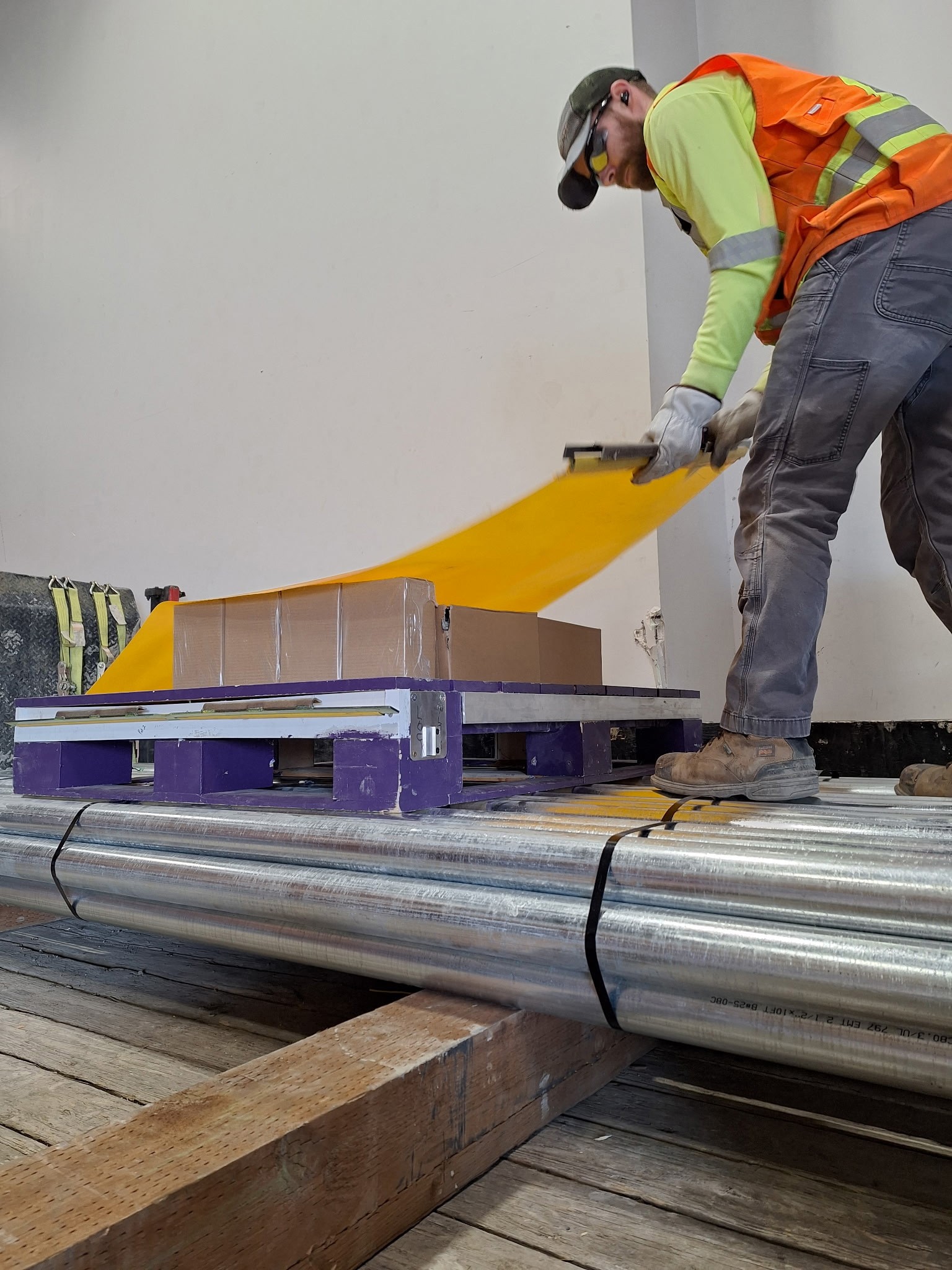
That's what PEER Pallets is designed to do.
PEER Pallets System Feature | Hygiene Implication |
|---|---|
HDPE pallet construction | Non-porous, FDA-compatible, sanitizable |
Built-in reusable wrap stored in a protected compartment | Wrap is not exposed to floors, forklifts, or contamination between uses |
Wrap material is cleanable and quick-drying | Can be wiped, pressure-washed, or steam-cleaned as part of standard pallet sanitation |
Reusable indefinitely | No single-use film entering or leaving food environments |
No utility knives required to open loads | Eliminates blade contact with packaging, reduces WCB claims, removes metal shard contamination risk |
Full load securement in under 80 seconds | Faster than manual wrap, documented by RFID for audit trail |
The goal isn't to make stretch wrap slightly more hygienic. It's to treat the wrap itself as transportation equipment — designed, cleaned, and reused under the same logic that already governs the pallet.
The Bottom Line
IMARC's $10.09 billion projection is real. The demand for hygienic pallets is real. The regulatory tailwind pushing food and pharmaceutical companies away from wood is real.
What's not real is the idea that replacing the pallet solves the hygiene problem while leaving the wrap untouched. The industry has built a $10 billion story around food-safe pallets and quietly allowed the wrap to stay outside that story — because a wrap that can't be validated for food contact, that has to be thrown away after every trip, and that is manufactured in environments with no food-grade standards is worth billions a year to somebody.
It's not worth billions to the companies buying it. And it's not worth the regulatory risk the moment an inspector or a plaintiff's lawyer asks why your FDA-compliant pallet is inside an "industrial use only" film.
The food and beverage industry has already decided that wooden pallets are not good enough. The next conversation — whether the industry wants to have it or not — is about what's wrapped around them.
About the research: This analysis is based on IMARC Group's Global Plastic Pallets Market Report (2025–2033), FDA guidance on Listeria monocytogenes in Refrigerated or Frozen Ready-to-Eat Foods, the Food Safety Modernization Act (2011), and published technical specifications distinguishing food-grade cling film from industrial pallet stretch wrap.
Ready to close the gap in your hygiene chain? Contact PEER Pallets to learn how our built-in reusable wrapping system carries food-safe logic all the way through load securement — no single-use industrial film required.