Global Pallet Market Size


The $122 Billion Question: Why Is a "Growing" Market Built on Consumption?
Precedence's $122B projection by 2034 measures continuous replacement spending, not efficiency. Nestable pallets (44.6% share) optimize moving empty assets—revealing an industry designed around circulating pallets rather than keeping them with products.
Published By:
Fortune Business Insights
The Market Forecast Everyone Celebrates
Precedence Research projects the global pallets market will reach $122.08 billion by 2034, growing at 5.30% annually from its current $76.70 billion size.
Industry analysts point to impressive drivers:
E-commerce expansion
Warehouse automation
Rising international trade volumes
Transition to "circular economy"
Growing plastic pallet adoption
But here's what the market projections reveal when you look closer: growth is based on consumption acceleration, not innovation.
The $122 Billion Consumption Engine
Let's break down what "market growth" actually means:
Market Component | 2025 Value | 2034 Projection | What This Really Represents |
|---|---|---|---|
Total Market | $76.70B | $122.08B | Annual spending on pallet purchase, rental, and replacement |
Asia Pacific (33% share) | ~$25.31B | $40.90B | Fastest-growing consumption region due to industrialization |
HDPE Segment (73% share) | ~$55.99B | Data not specified | Dominance of plastic pallets requiring eventual replacement |
Food & Beverage (23.9% end-use) | ~$18.33B | Data not specified | Single largest consuming sector |
Notice what's measured: spending. Not efficiency gains. Not waste reduction. Not total cost of ownership improvements.
The market grows because businesses keep buying pallets, renting pallets, repairing pallets, replacing pallets, and wrapping every load with stretch film.
The "Circular Economy" That Isn't
Industry reports celebrate the "transition to a circular economy" as a dominant trend, emphasizing:
Reuse and repair
Recycling programs
Bio-based materials
Eco-friendly designs
But examine what circular actually means in practice:
Traditional "Circular" Wooden Pallet Model:
Manufacture pallet ($30-40)
Use 3-4 trips
Repair ($15-25 labor + materials)
Repeat repairs 3-4 times
Recycle into mulch/fuel
Buy new pallet
Wrap with stretch film on every trip throughout
"Advanced" Plastic Pallet Model:
Manufacture pallet ($120-150)
Use 20-30 trips
Minor repairs after 50+ trips
Eventually dispose after 100+ trips
Buy new pallet
Wrap with stretch film on every trip throughout
Both models:
Assume eventual replacement
Require continuous stretch wrap consumption
Generate recurring revenue for manufacturers
Consume energy and materials throughout lifecycle
That's not circular. That's slower consumption with recycling at the end.
The HDPE Dominance Story
Research shows HDPE holds 73% of the material segment due to:
Simple maintenance
Impact resistance
Solvent and corrosion resistance
Minimal damage from forklift handling
Chemical and weather resistance
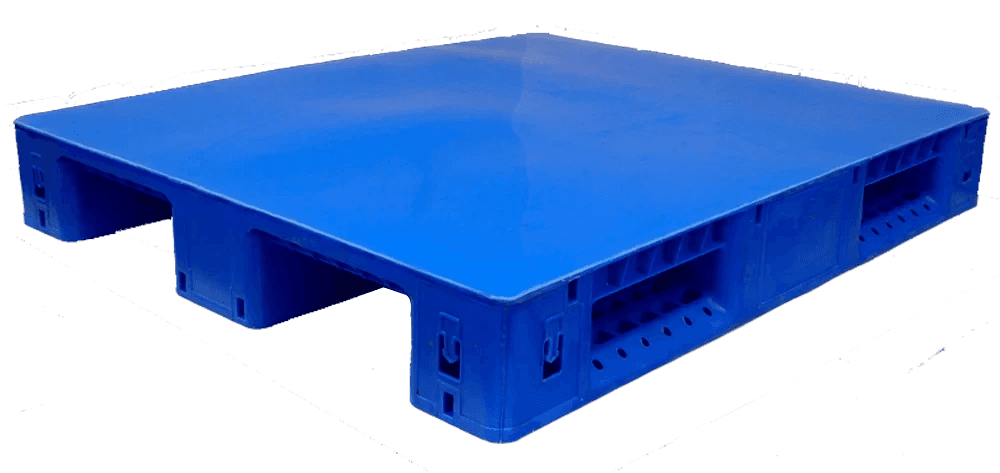
These are genuine advantages over wood. But notice what's missing from the benefits list:
Eliminates stretch wrap consumption
Stops replacement cycle
Reduces total cost of ownership to zero after initial investment
The industry optimizes material durability while ignoring operational waste.
The Nestable Pallet Trap
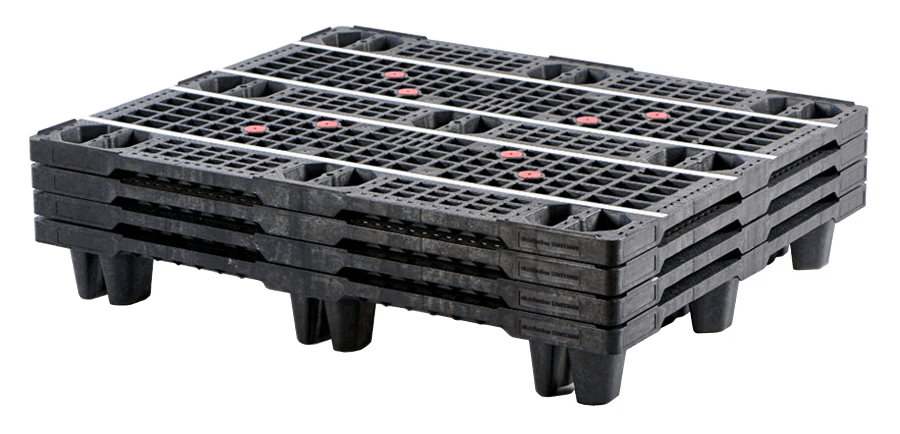
Nestable pallets hold 44.6% of the type segment because they:
Nest inside each other
Reduce return freight space
Cost less than rackable/stackable pallets
Work well for export applications
Here's the problem: they're optimized for a system that assumes continuous pallet movement and replacement.
Why nestable pallets exist:
Pallets travel one direction full, return empty
Empty pallet transport costs money and space
Nesting reduces that specific cost
What this reveals:
The entire pallet rental/pooling model depends on constant circulation
Efficiency improvements focus on moving empty pallets cheaper
Nobody questions why pallets need to return empty in the first place
PEER Pallets doesn't nest because our pallets don't need to travel empty—they stay with the merchandise as an integrated asset.
The Food & Beverage Sector Reality
Food and beverage represents 23.9% of market demand due to:
Hygiene requirements
Moisture resistance needs
Frequent handling of fresh produce
Meat, dairy, and processed food transport
The sector has increasingly adopted plastic pallets because they:
Don't absorb contaminants
Can be cleaned and sanitized
Don't harbor bacteria or mold
But even with premium plastic pallets, the sector still:
Wraps every load with single-use stretch film
Replaces pallets every few years
Operates rental/pooling systems requiring continuous logistics
Generates plastic waste on every shipment
For an industry focused on food safety and hygiene, the tolerance for single-use plastic waste is remarkable.
The Asia Pacific Growth Engine
Asia Pacific leads with 33% market share, projected to grow at the fastest rate due to:
Rapid industrialization
Exponential e-commerce growth
Expanding logistics networks
Rising freight volumes
Translation: the region consuming resources fastest is consuming more resources faster.
China and India's industrialization drives demand. But look at what that demand represents:
Hundreds of millions of new pallets manufactured annually
Billions of tons of stretch wrap consumed
Massive energy consumption for pallet production and transport
Enormous end-of-life disposal challenges in regions with limited recycling infrastructure
The fastest-growing market isn't adopting the most efficient system. It's scaling the existing consumption model.
The Raw Material Volatility Problem
Research identifies raw material price volatility as a key challenge:
Polyethylene (PE) prices fluctuating
Polypropylene (PP) prices unstable
Supply chain instability driving costs up
Increased production costs reducing profit margins
This matters because:
73% of pallets use HDPE (petroleum-derived)
PP pallets are premium products with even higher material costs
Price fluctuations affect entire value chain
Manufacturers and end-users both absorb cost increases
Here's the irony: companies investing in "sustainable" plastic pallets are locked into a system where petroleum price volatility determines their operational costs.
The Automation Investment Misdirection
Market reports celebrate warehouse automation as a major driver, highlighting:
Compatibility with automated handling systems
RFID tracking integration
Robotics adoption
AI-driven sorting systems
But automation investments optimize the wrong process:
Faster pallet handling (still requires stretch wrap)
Better pallet tracking (still requires replacement cycle)
Smarter logistics (still assumes rental/pooling model)
Improved sorting (still generates plastic waste)
Companies are spending millions to automate an inefficient system rather than eliminate the inefficiency.
The Pharmaceutical Sector Contradiction
Pharmaceuticals demand plastic pallets due to hygiene requirements:
Cannot risk contamination
Need easy cleaning and sterilization
Require consistent, reliable performance
Must maintain product integrity
Yet the sector accepts:
Single-use stretch wrap that cannot be sterilized after use
Pallet rental systems that introduce variables into sterile supply chains
Multiple touch points as pallets circulate through pooling networks
Plastic waste generation in an industry focused on health
If contamination is the concern, why accept single-use plastic that touches every product on every shipment?
The E-Commerce Paradox
E-commerce expansion drives market growth because:
Online retail requires extensive warehousing
Last-mile delivery needs efficient packaging
Returns processing demands flexible logistics
Direct-to-consumer shipping scales pallet usage
But e-commerce companies are simultaneously:
Setting aggressive sustainability goals
Committing to zero waste targets
Promising carbon neutrality
Marketing environmental responsibility
While consuming pallets and stretch wrap at unprecedented rates.
The Real Market Opportunity
Precedence Research projects $122.08 billion in market value by 2034. But that figure represents an opportunity the industry isn't addressing:
What $122B in annual spending reveals:
Businesses want efficient material handling (they spend $122B on it)
Current solutions require continuous spending (hence market "growth")
System optimization focuses on material improvements, not operational efficiency
Nobody's eliminating the need for continuous spending
Here's the actual opportunity: what if companies could achieve the same handling efficiency without continuous spending?
The PEER Pallets Market Position
Market research identifies growth drivers:
Plastic pallet adoption (HDPE dominance at 73%)
Circular economy focus (reuse and recycling)
Automation compatibility (RFID and tracking)
Hygiene requirements (food, beverage, pharmaceutical)
Durability improvements (longer service life)
PEER Pallets addresses all of these—and eliminates what they ignore:
Market Trend | Industry Response | PEER Pallets Response |
|---|---|---|
Plastic adoption | HDPE pallets with 8-10 year lifespan | HDPE construction with 10-year design life |
Circular economy | Repair and eventual recycling | True circularity: no repairs needed, full recyclability at actual end of life |
Automation compatibility | RFID tracking for pooling logistics | Integrated solution eliminates pooling logistics |
Hygiene requirements | Cleanable plastic pallets + stretch wrap | Cleanable plastic pallets + reusable integrated wrap |
Durability improvements | Better materials, fewer repairs | Zero consumables throughout entire service life |
We don't participate in the $122B consumption market. We offer an alternative to it.
The Investment Thesis Nobody Questions
Market reports note that investment flows from:
Major logistics companies
Private equity firms (KKR, Carlyle Group)
Manufacturing giants
Pallet pooling operators
Attracted by:
Strong profit margins
High technical barriers to entry
Alignment with ESG goals
Recurring revenue models
Translation: investors love a business where customers must keep paying forever.
But here's the uncomfortable question: if the business model requires continuous customer spending to generate returns, who's actually capturing value?
The Startup Ecosystem Focus
Research highlights innovation in:
Smart pallets with sensors
AI-driven sorting systems
Novel bio-based materials
Robotics for pallet processing
These are genuine technological advances. But notice what they optimize:
Better tracking (of assets that still need replacing)
Faster sorting (of assets that still need wrapping)
New materials (that still become waste at end of life)
Improved processing (of disposal and recycling)
Nobody's innovating on eliminating the consumption cycle itself.
The Regional Expansion Reality
Market growth is global:
North America: Established logistics infrastructure
Europe: Mature, regulated, standardized
Asia Pacific: Rapid industrialization (fastest growth)
Latin America: Expanding logistics networks
MEA: Infrastructure investments
Each region scales the same consumption model:
Purchase or rent pallets
Wrap every load with stretch film
Repair pallets multiple times
Eventually recycle or dispose
Repeat continuously
Geographic expansion doesn't mean innovation. It means replicating the existing system in more locations.
The $122B Reality Check
A market projected to reach $122 billion by 2034 sounds like success. But ask what that number measures:
It's not measuring:
Problems solved
Waste eliminated
Efficiency gained
Total costs reduced
It's measuring:
Money spent
Pallets consumed
Materials processed
Revenue generated from continuous replacement
Growth in this market means businesses are spending more, not spending less.
The Alternative Path
Research identifies what the market values:
Durability (HDPE pallets dominating)
Hygiene (plastic over wood in sensitive sectors)
Compatibility (standardization and automation)
Sustainability (circular economy focus)
PEER Pallets delivers all of this. But we add what the market doesn't measure:
Elimination of recurring costs
Zero stretch wrap consumption
No replacement cycle
True lifecycle efficiency
We're not competing for share of the $122B consumption market. We're offering companies an exit from it.
The pallet market will reach $122 billion because companies keep spending on consumption. Ready to stop contributing to market growth and start capturing value instead? Contact PEER Pallets to learn how our integrated system delivers material handling efficiency without the recurring costs.